How to Brief a Graphic Designer (With a Simple Template)
Most design revisions come from unclear briefs, not bad designers. Here's what to include so your posts, ads, brochures and packaging come back right the first time.
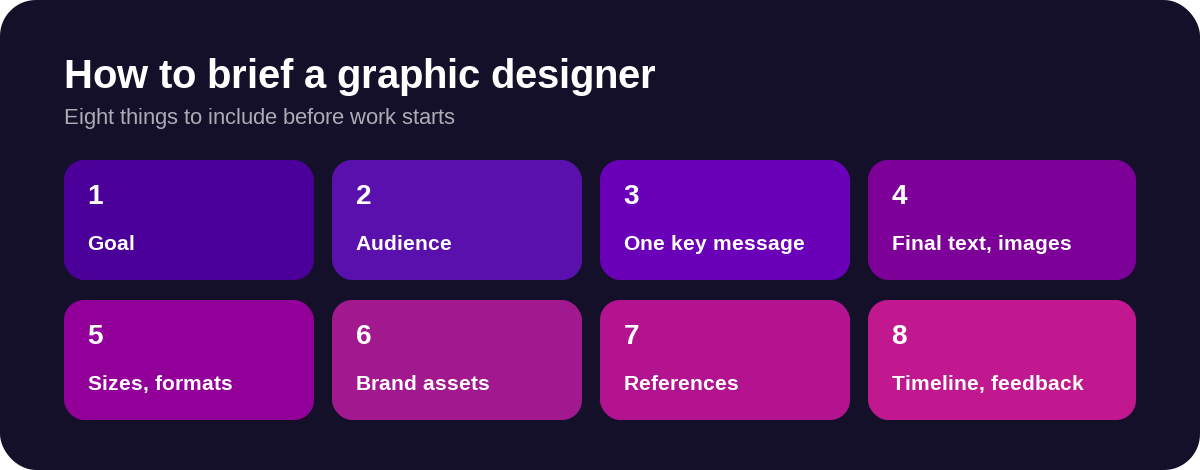
A good design brief tells the designer what the design must achieve, who it's for, the one message it must communicate, the exact text, sizes and formats, your brand assets, references you like and dislike, the deadline and how feedback will work. Write it down in one place, share final copy and logo files up front, give consolidated feedback tied to the goal, and agree the number of revision rounds before work starts.
Start with the goal and audience, then the one key message.
Give final text, exact sizes and formats, and your brand assets up front.
Share references you like and dislike, and say why.
Agree deadlines and revision rounds; give consolidated, goal-based feedback.
A good design brief tells the designer what the design must achieve, who it's for, the one message it must get across, the exact text and sizes, your brand assets, references, the deadline and how feedback will work. Most extra revisions come from unclear briefs, not bad designers.
Whether you're ordering social posts, an ad, a brochure or packaging, this guide and template will help you get the right result faster.
What a good brief covers
1. Goal: what should this design do?
Be specific. "Get 50 bookings for the weekend brunch offer" is far more useful than "a nice post for brunch". The goal guides every decision the designer makes, from layout to how big the offer appears.
2. Audience: who is it for?
Describe the people who will see it: age, location, what they care about and where they'll see it (scrolling Instagram, a shop counter, an exhibition stand). A design for busy professionals on a phone needs different choices from one for a printed catalogue.
3. The one key message
If people remember only one thing, what should it be? Write it in one sentence. Everything else in the design supports that message.
4. Content: final text and images
Final, approved text, including headline, offer, prices, terms, contact details and call to action. Late text changes cause the most revisions.
Images you want used (product photos, team photos) in the highest resolution you have.
Platform, format (post, story, Reel cover), aspect ratio, number of variations
Ads
Each placement and size, text limits
Print
Final size, bleed, CMYK or Pantone, paper, print-ready PDF
Web
Pixel size, file type (WebP, PNG, SVG), mobile and desktop versions
Check each platform's current specifications. For example, Instagram's help centre says Reels can be uploaded with aspect ratios between 1.91:1 and 9:16.
For anything people need to read, ask for accessible contrast; WCAG 2.2 recommends at least 4.5:1 for normal text. Our free colour contrast checker can test it.
7. References: what you like and dislike
Share 3 to 5 examples you like and 1 or 2 you don't, and say why: "clean layout with lots of space", "too busy", "love this colour mood". References save hours of guessing.
8. Timeline, budget and feedback
Deadline for first drafts and final files, with any launch date.
Budget or quote reference.
Revision rounds included (agree before starting).
Who gives feedback and who approves. One decision-maker avoids conflicting comments.
A simple brief template
Project:
Goal (measurable if possible):
Audience and where they'll see it:
One key message:
Final text (headline, body, offer, CTA, contact):
Images provided / needed:
Mandatory items (logos, legal lines):
Outputs and exact sizes:
Brand assets attached (logo, colours, fonts, guidelines):
References we like (and why):
References we don't like (and why):
Deadline (drafts / final):
Budget:
Revision rounds included:
Feedback and approval by:
How to give good feedback
Consolidate: collect everyone's comments into one list.
Tie it to the goal: "The offer isn't noticeable enough for people scrolling fast."
Describe the problem, not the fix: let the designer solve it.
Be specific: "headline", "second image", "price text", not "make it pop".
Approve in writing once you're happy, so final files can be prepared.
The bottom line
A clear brief with the goal, audience, one message, final text, exact sizes, brand assets, references, timeline and feedback process gets better designs in fewer rounds. Spend twenty minutes on the brief to save days of revisions.
The goal, audience, key message, final text, sizes and formats, brand assets (logo, colours, fonts), references, deadline, budget and how many revision rounds are included.
Should I give the designer the final text?
+
Yes. Changing text after the layout is done is one of the most common causes of extra revisions. Share final, approved copy with the brief.
How do I give good design feedback?
+
Collect everyone's comments into one list, tie each point to the goal or audience, and describe the problem rather than the solution, such as 'the offer isn't noticeable' rather than 'make it red'.
How many revisions are normal?
+
Many designers include two or three rounds of revisions in a quote. Agree the number before work starts, and check it in the proposal.
What sizes should I ask for social media?
+
It depends on the platform and format. For example, Instagram supports Reels between 1.91:1 and 9:16. Check each platform's current specifications and list the exact sizes you need in the brief.
Articles are written and reviewed by the Incinc Media team, the people who plan, design, build and market websites, apps and campaigns for businesses from our head office in Mumbai and our branch offices in Faridabad and Greater Noida. We write about the questions clients ask us every week.
Share your brief or just your goal. Our in-house designers create social posts, ads, brochures, packaging and brand assets, with clear revision rounds.
A logo is how people recognise you. A brand identity is the system that makes everything you publish look and sound like you. Here's the difference, and what to get first.
Brand guidelines keep your business looking and sounding the same everywhere. Here's what to include, what to skip and how to make them something your team actually uses.
A clear brief is the cheapest way to get a better video and a more accurate quote. Here's exactly what to tell a production company and a template to start from.
Read
Start a project
Telluswhat you'rebuilding.
Whether you need a digital product, a creative campaign or a complete digital transformation, let's build something meaningful together.