Hiring a Remote or Offshore Agency? A Contract Checklist Before You Sign
When your agency is in another country, the contract does more work. Here's a clause-by-clause checklist for scope, payments, ownership, data, accounts and what happens if things go wrong.
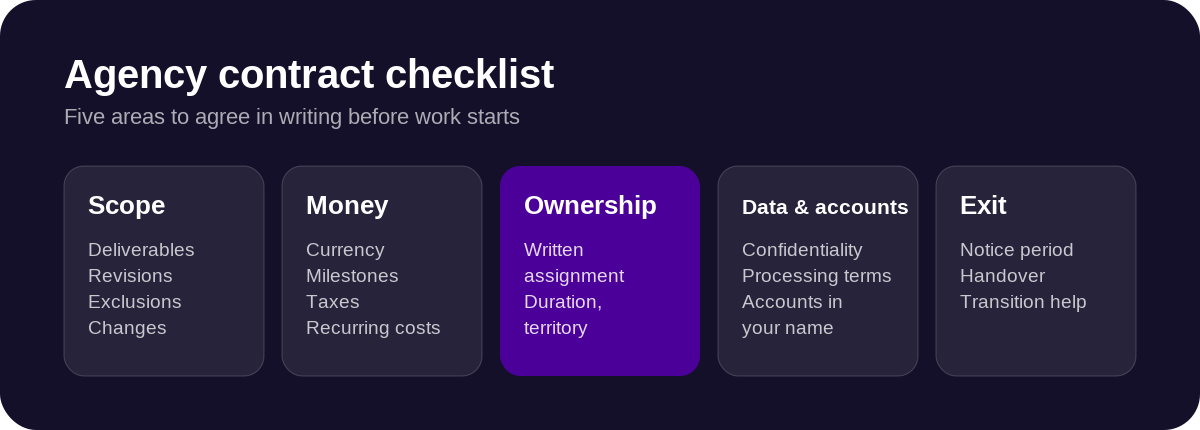
A contract with a remote or offshore agency should define the scope and deliverables, milestones and payment terms, change requests, IP ownership and assignment (in writing, with rights, duration and territory stated), source-code and account handover, third-party licences, confidentiality and data protection (including a data processing agreement where laws such as the GDPR apply), warranties and support, governing law and dispute resolution, and exit terms. Keep domains and key accounts in your own name.
Scope, milestones and change requests prevent most disputes.
IP assignment should be written, and should state the rights, duration and territory.
If the agency handles personal data for you, you may need a data processing agreement.
Exit terms matter as much as start terms: handover, notice and what you get if you leave.
When your agency is down the road, a misunderstanding can be fixed over coffee. When it's in another country and time zone, the contract carries more of the weight. A clear agreement protects both sides and makes the project calmer for everyone.
Here's a clause-by-clause checklist for hiring a remote or offshore web, app, video or marketing agency. It isn't legal advice; use it to prepare for a conversation with your lawyer and your agency.
Five areas every agency contract should cover
1. Scope and deliverables
A written list of deliverables: pages, features, designs, videos, campaigns
Assignment of deliverables to you on payment, in writing. Under India's Copyright Act, 1957, an assignment must be in writing, signed, and should identify the work and state the rights, duration and territory. If duration or territory are left out, the Act applies narrower defaults, so state them explicitly (for example, worldwide and perpetual).
What the agency keeps: its own pre-existing code, tools, templates and know-how, usually licensed to you for use in your project
Third-party licences (fonts, themes, plugins, stock media, music) and in whose name they're bought
Portfolio rights: whether the agency may show the work publicly
5. Source code, files and accounts
Repository access during the project, or code handover at each milestone
Final source files for designs and videos, in agreed formats
Domain, hosting, analytics, Search Console, ad accounts and app store accounts registered in your company's name, with the agency added as a user
A handover document: logins, how to deploy, how to edit content
6. Confidentiality and data protection
Confidentiality of your business information
If the agency will handle personal data (customer lists, form submissions, user accounts), a data processing agreement. In the EU, GDPR Article 28 requires one between controller and processor.
How data is stored, accessed and deleted at the end
Local laws that apply to you, such as India's DPDP Act, 2023 or the UAE's federal data protection law
7. Quality, warranties and support
A bug-fix warranty period after launch
Support and maintenance terms if you want them: response times, what's covered, monthly cost
Security basics: updates, backups, access control
8. Governing law and disputes
Which law governs the contract
How disputes are resolved: negotiation first, then mediation or arbitration, and where
Limitation of liability that's reasonable for both sides
9. Exit terms
Notice period for ongoing retainers
What you receive if the project stops midway: completed work, files and code paid for so far
Transition help if you move to another provider
Questions to ask before signing
Can I see a sample proposal and contract?
Who will I speak to each week, and who does the work?
When and how will I get access to the code and files?
Whose name will the domain, hosting and accounts be in?
What happens if we need to stop the project?
The bottom line
A good remote agency will be glad to put scope, payments, ownership, data and exit terms in writing. If a partner resists any of these, treat it as a warning. Clear paperwork lets everyone focus on the work.
Not necessarily. Ownership depends on the law and your contract. Under India's Copyright Act, an assignment must be in writing and should state the rights, duration and territory. Make sure your agreement transfers the deliverables to you.
What is a data processing agreement?
+
A contract that sets out how a service provider handles personal data on your behalf. Under the EU GDPR, Article 28 requires one when a processor handles personal data for a controller.
Which country's law should govern the contract?
+
It's a commercial decision. Both parties should understand where disputes would be heard and how. Many cross-border agreements choose arbitration for practicality. Take legal advice for your situation.
Should source code be held in escrow?
+
For most websites, handing over the code repository and access at each milestone is simpler than escrow. Escrow can make sense for critical, long-running software where the vendor keeps the code.
Is this legal advice?
+
No. This is a practical checklist to discuss with your lawyer and your agency.
Articles are written and reviewed by the Incinc Media team, the people who plan, design, build and market websites, apps and campaigns for businesses from our head office in Mumbai and our branch offices in Faridabad and Greater Noida. We write about the questions clients ask us every week.
Outsourcing a website to India can work brilliantly or painfully. The difference is rarely talent. It's scope, communication, ownership and process. Here's how to set it up properly.
Mumbai has hundreds of web agencies and freelancers. Here's how to shortlist, question and compare them so you end up with a website that works and a partner you can rely on.
Read
Start a project
Telluswhat you'rebuilding.
Whether you need a digital product, a creative campaign or a complete digital transformation, let's build something meaningful together.