How to Outsource Web Development to India: A Practical Guide for Overseas Businesses
Outsourcing a website to India can work brilliantly or painfully. The difference is rarely talent. It's scope, communication, ownership and process. Here's how to set it up properly.
To outsource web development to India successfully, shortlist agencies with live work you can inspect and references from clients in your region, share a written brief, insist on an itemised proposal with milestones, agree a regular call slot across time zones, put IP ownership and source-code handover in the contract, keep domains and hosting in your own name, and plan for SEO, hreflang and performance in your target market. Judge partners on clarity and process as much as on price.
Choose on evidence: live sites, process and references, not portfolio screenshots alone.
A written scope and milestone plan prevents most cross-border problems.
India Standard Time (UTC+5:30) overlaps well with the Gulf, partly with Europe; plan US calls deliberately.
Put IP ownership, handover and account ownership in writing, with duration and territory stated.
Businesses in the Gulf, Europe, the UK, the US and Australia regularly hire Indian agencies for websites, apps and digital work. Many of those projects go smoothly. Some don't, and when they fail, it's rarely because of skill. It's unclear scope, poor communication, missing paperwork or accounts held by the wrong person.
This guide is a practical playbook for getting it right. We're a Mumbai studio that works with clients abroad, so we've written it from both sides of the table.
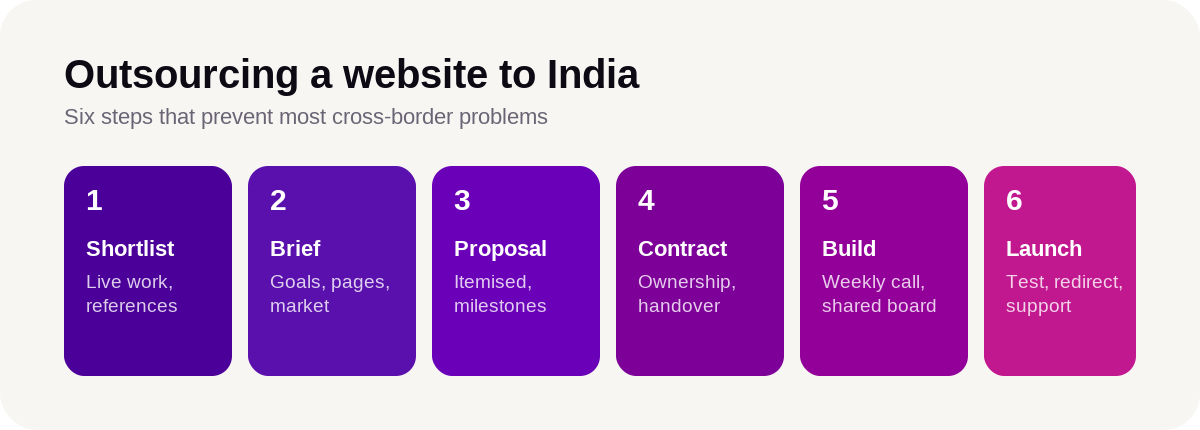
Six steps to outsourcing well
1. Shortlist on evidence, not promises
Open their live websites on your phone. Are they fast? Do forms work? Does the design feel current?
Look for work in your region or language. A partner who has built for your market already understands your audience.
Ask about process: who you'll speak to, how feedback works, how changes are handled.
Speak to a past client if you can, ideally one outside India.
India Standard Time is UTC+5:30, with no daylight saving.
Your location
Overlap with an Indian working day
UAE, Saudi Arabia, Qatar
Almost the whole day
UK and Europe
Your morning is India's afternoon
US East Coast
Little natural overlap; plan an early-morning or evening call
Australia
Your afternoon is India's morning
What works: one fixed weekly call, feedback in a shared board, and written summaries after decisions. Progress then continues while you sleep.
5. Get the paperwork right
Before work starts, the contract should cover:
Ownership of deliverables on payment. Under India's Copyright Act, an assignment must be in writing and should name the rights, duration and territory; if they're not stated, narrower defaults apply.
Source code and file handover at the end.
Confidentiality and how your data is handled.
Third-party licences for fonts, themes, plugins and stock assets.
Register the domain, hosting, analytics, Search Console, ad and app store accounts in your company's name, and add the agency as a user. It's the single best protection against getting locked out later.
7. Build for your market, not the agency's
Language and tone written for your audience, not translated as an afterthought
Currency, units and date formats that match your market
Legal pages for your country: privacy, cookies, terms
Hreflang if you have more than one language or region (Google's guide)
Hosting and CDN that are fast for your visitors; check Core Web Vitals from your region
Test on the devices and browsers your customers use
Set up redirects from any old site to protect SEO
Submit the sitemap in Google Search Console and Bing Webmaster Tools
Agree a support window for fixes after launch
Red flags
A fixed price with no written scope
Reluctance to show live work or put you in touch with clients
The agency registering your domain or hosting in its own name
No mention of source-code handover
Very large upfront payments before any design is approved
The bottom line
Outsourcing to India works best when you treat it like any important hire: choose on evidence, write things down, keep your accounts in your name and agree a rhythm that works across time zones. Do that, and distance becomes a non-issue.
It can be, with the same safeguards you'd use anywhere: a written contract, milestone payments, your own accounts for domain and hosting, and a clear handover of code and logins. Check live work and speak to past clients.
How do I handle the time difference?
+
India Standard Time is UTC+5:30 with no daylight saving. Agree a fixed weekly call that overlaps both working days and keep feedback in a shared board so progress continues between calls.
Who owns the code if an Indian agency builds my website?
+
Ownership depends on your contract. Under India's Copyright Act, an assignment must be in writing and should state the rights, duration and territory; if those are missing, defaults apply. Make sure the agreement transfers the deliverables to you.
Should I hire freelancers or an agency?
+
Freelancers can suit small, well-defined tasks. An agency suits projects that need design, development, content, SEO and support together, with continuity if one person is unavailable.
Can an Indian agency build a site for my local market?
+
Yes, if they plan for your audience: language, currency display, local legal pages, hreflang for multiple languages, and hosting that's fast for your visitors.
Articles are written and reviewed by the Incinc Media team, the people who plan, design, build and market websites, apps and campaigns for businesses from our head office in Mumbai and our branch offices in Faridabad and Greater Noida. We write about the questions clients ask us every week.
When your agency is in another country, the contract does more work. Here's a clause-by-clause checklist for scope, payments, ownership, data, accounts and what happens if things go wrong.
A UAE website has a few things to get right that a generic template ignores: English and Arabic, right-to-left layouts, .ae domains, data protection, VAT-inclusive pricing and fast mobile pages.