
SEO & AI Search · 2 min read
SEO Basics for Service Businesses
You don't need to be an expert to get the fundamentals right. These basics help customers find your services on Google.
Read
Most business blogs fail for one of two reasons: they answer questions nobody asks, or they answer them worse than everyone else. Here's a method that avoids both.
Quick answer
Write SEO-friendly blog articles by starting from a real customer question with search demand, matching the search intent, and answering it better than existing results with your own experience. Use a clear structure: a direct answer near the top, descriptive headings, lists or tables, sources for facts, a specific title and meta description, helpful images with alt text, and links to your relevant service pages and related articles. Publish consistently and update older posts as facts change.
A business blog should do two jobs: get found by people with questions, and turn some of them into enquiries. Most blogs do neither, usually because the topics are chosen from a keyword list rather than real customer questions, or because the articles say what every other page says.
Here's the method we use for every article on this site.
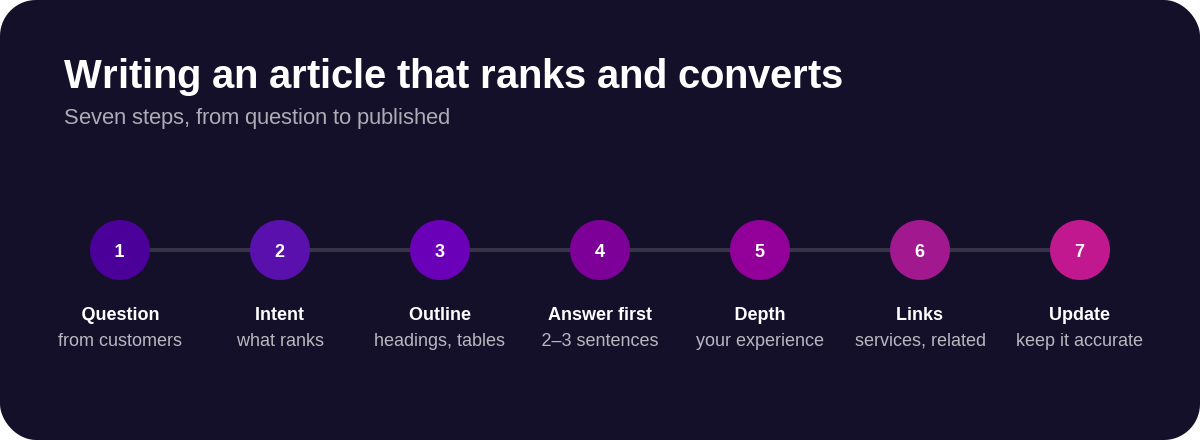
The best topics come from your inbox, calls and WhatsApp chats:
Then check that people search for it: Google's autocomplete and "People also ask" show how they phrase it.
Search the question yourself and look at what ranks.
| Intent | What the reader needs | Format |
|---|---|---|
| Cost | Ranges, factors, hidden costs | Breakdown with tables |
| Comparison | A fair side-by-side and a recommendation | Comparison table + "choose X if…" |
| How-to | Clear steps | Numbered steps, screenshots or diagrams |
| Choosing a provider | Criteria, questions, red flags | Checklist |
Put a two-to-three sentence answer near the top. Then add what generic pages can't:
Google's guidance on helpful, people-first content is the standard to write against.
AI can speed up outlines and first drafts. Google's guidance on AI-generated content focuses on whether content is helpful, not how it was produced. Publish only what an expert has checked, corrected and enriched with real experience. Never publish invented statistics, quotes or reviews.
SEO-friendly articles start with real customer questions, match what searchers want, answer clearly and add your own experience. Link them into your site, keep them accurate and publish consistently, and they'll keep bringing both visits and enquiries.
Our SEO team plans and writes content this way. To see how AI search uses articles, read how AI Overviews affect SEO.
As long as it takes to answer the question well, and no longer. Some topics need 600 words, others 2,000. Google doesn't rank by word count; it rewards helpful, complete answers.
One main topic, with the natural related phrases people use. Writing clearly about one question usually covers the variations without forcing them.
AI can help with outlines and drafts, but publish only what an expert has checked, edited and enriched with real experience, examples and accurate facts. Google's guidance focuses on whether content is helpful, not how it was produced.
Consistency matters more than volume. A useful article every week or two, kept up for months, usually beats a burst of posts followed by silence.
Yes. Refresh facts, prices, screenshots and links, add new questions customers ask, and update the date only when the content meaningfully changes.
Written by
Articles are written and reviewed by the Incinc Media team, the people who plan, design, build and market websites, apps and campaigns for businesses from our head office in Mumbai and our branch offices in Faridabad and Greater Noida. We write about the questions clients ask us every week.
Want a blog that brings enquiries?
We plan topics from real customer questions, write and design the articles, and link them to your services.
SEO & AI Search · 2 min read
You don't need to be an expert to get the fundamentals right. These basics help customers find your services on Google.

SEO & AI Search · 3 min read
AI Overviews answer some questions right on the results page. That changes which searches send clicks, not whether SEO matters. Here's what Google says, and what to do.
SEO & AI Search · 6 min read
Great content can't rank if search engines can't crawl, understand and trust your pages. Use this checklist to find the technical issues that quietly hold business websites back.
Start a project
Whether you need a digital product, a creative campaign or a complete digital transformation, let's build something meaningful together.
Or call +91 81081 14819·mail@incincmedia.com