

Web Design & UX · 2 min read
The Anatomy of a Landing Page That Converts
A landing page has one job. Here's the structure that helps visitors understand your offer and take action.
Read
A landing page and a website do different jobs. One converts visitors from a specific campaign; the other builds trust and gets found over time. Here's how to choose, and why most businesses need both.
Quick answer
A landing page is a single, focused page built for one goal, usually converting visitors from a specific ad or campaign into enquiries or sales. A website is a set of pages that explains your whole business, builds trust and gets found in search over time. A landing page alone can work for a single offer, event or test campaign; most businesses need a website as their permanent home, plus dedicated landing pages for ads, because focused pages that match the ad usually convert better.
A landing page is a single, focused page built to turn visitors from one campaign into enquiries or sales. A website is a set of pages that explains your whole business, builds trust and gets found in search over time. Most businesses need a website as their permanent home and dedicated landing pages for ads and campaigns.
The choice matters because each does a different job, and using one for the other's job wastes money. Here's how to decide.
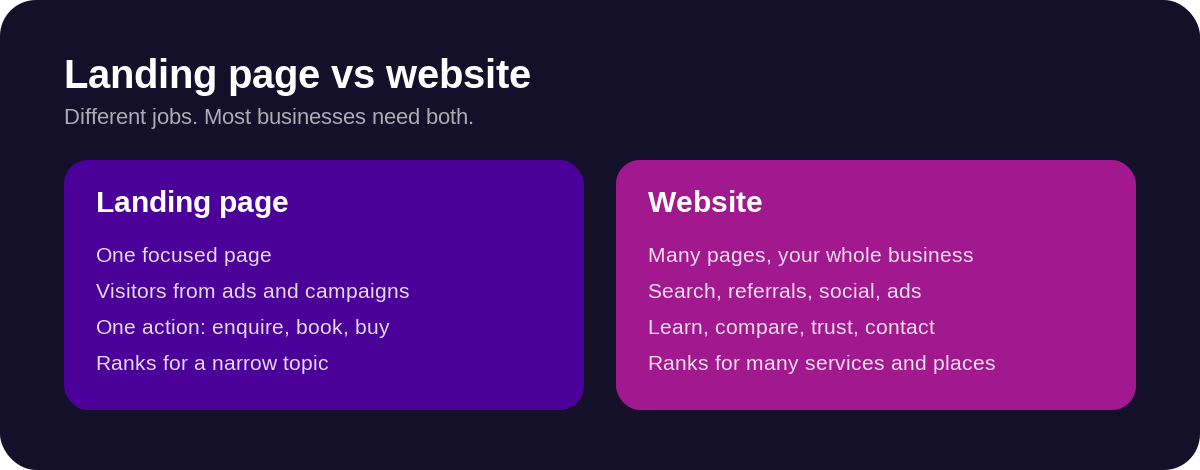
| Landing page | Website | |
|---|---|---|
| Purpose | Convert visitors from one campaign | Represent your whole business |
| Pages | One focused page | Many pages: services, work, about, contact, articles |
| Visitors | Mostly from ads, emails or social posts | From search, referrals, ads, social and direct |
| Goal | One action: enquire, book, buy or download | Many: learn, compare, trust, contact |
| Navigation | Minimal, to avoid distractions | Full menu so people can explore |
| SEO | Can rank for a narrow topic | Can rank for many services, questions and locations |
| Lifespan | Often tied to a campaign | Permanent, improved over time |
Even then, plan for a website soon, especially if you want to appear in search and build long-term trust.
When someone clicks an ad for "website design for clinics", sending them to your home page makes them hunt for what they clicked on. A landing page that matches the ad keeps the promise and makes the next step obvious.
Google measures this. Its Quality Score for Search campaigns is built from expected clickthrough rate, ad relevance and landing page experience, which looks at how relevant and useful the page is to people who click your ad. Google's advice includes keeping the message consistent from ad to page and making sure the page delivers what the ad offers.
If your ads aren't bringing enquiries, the page is often the problem. See why your Google Ads aren't generating leads.
The strongest setup uses both:
Landing pages can live on your main domain (for example yourbrand.com/offer) so they benefit from your brand and tracking, and are easy to update.
Our anatomy of a landing page walks through each section.
A landing page converts visitors from a specific campaign; a website builds trust and gets found. Use a landing page alone only for a single offer or test. For most businesses, the answer is both: a solid website as your home and focused landing pages for every campaign.
Our website development team builds websites and campaign landing pages that load fast and are built to convert.
A landing page is one focused page with a single goal, usually for a specific campaign. A website has multiple pages covering your services, work, team and contact details, and serves many visitors with different needs.
For a single offer, event or early test, sometimes. But a website builds more trust, ranks for many more searches and gives people a place to learn about your business, so most businesses outgrow a single page quickly.
Usually a landing page that matches the ad. Google's Quality Score includes landing page experience, which looks at how relevant and useful the page is to people who click your ad.
It can rank for a narrow set of searches if it has useful, indexable content. A website with several well-structured pages can rank for many more topics and locations.
A headline that matches the ad, a clear offer, proof such as reviews or work examples, answers to common objections and one obvious call to action. Our anatomy of a landing page guide covers it section by section.
Written by
Articles are written and reviewed by the Incinc Media team, the people who plan, design, build and market websites, apps and campaigns for businesses from our head office in Mumbai and our branch offices in Faridabad and Greater Noida. We write about the questions clients ask us every week.
Need a landing page, a website or both?
Tell us your goal and how you'll bring visitors. We'll recommend the right setup and build pages that are fast, focused and easy to update.
Web Design & UX · 2 min read
A landing page has one job. Here's the structure that helps visitors understand your offer and take action.
Website Development · 3 min read
Your Instagram can grow fast, but you don't own it, Google rarely shows it for buying searches, and it can't answer every question a customer has. A website does those jobs.
Google Ads & Meta Ads · 4 min read
When Google Ads don't bring leads, the problem is rarely 'Google Ads doesn't work for us'. It's usually tracking, search terms, the landing page or follow-up. Here's how to find which.
Start a project
Whether you need a digital product, a creative campaign or a complete digital transformation, let's build something meaningful together.
Or call +91 81081 14819·mail@incincmedia.com