Why Every Small Business Needs a Professional Website (Even with a Busy Instagram)
Your Instagram can grow fast, but you don't own it, Google rarely shows it for buying searches, and it can't answer every question a customer has. A website does those jobs.
Social media is great for attention, but a small business needs its own website because you own it, it can rank on Google for the searches customers make when they're ready to buy, it answers questions in depth, it builds trust, it gives ads a proper landing page and it's where AI search tools find facts about you. Platforms can change their rules or restrict accounts. Use social media to attract people and your website to convert them.
You don't own your social accounts; platforms can restrict or remove them under their terms.
Buying searches on Google usually show websites, maps and profiles, not Instagram posts.
A website answers detailed questions and builds trust before people contact you.
Use social to attract attention and your website to turn it into enquiries.
Many small businesses in India run entirely on Instagram and WhatsApp, and some do very well. So it's fair to ask: why spend on a website at all?
Because social media and a website do different jobs. Social media gets attention. A website turns attention into trust and enquiries, and keeps working when platforms change.
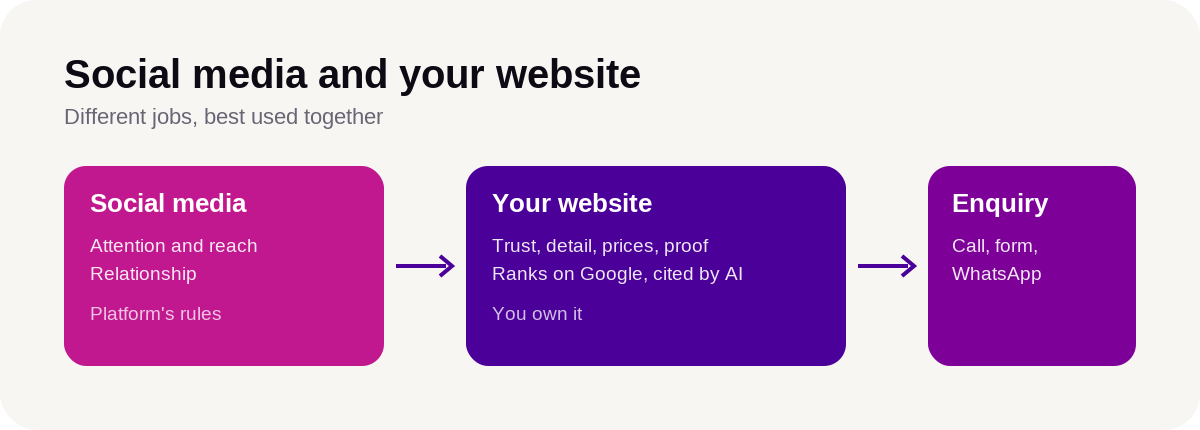
Social attracts, the website converts
1. You own your website. You rent your social accounts.
Your Instagram page exists under Instagram's rules. Its Terms of Use allow the platform to remove content or restrict accounts in various situations, and features and reach change often. A website on your own domain is yours: the content, the address and the customer relationship. See how to choose a domain name.
2. Buying searches show websites, not posts
When people are ready to buy, they search: "interior designer in Thane", "CA for GST filing near me", "packaging machine manufacturer Mumbai". Google shows websites, maps listings and business profiles for these, rarely Instagram posts.
Google advises complete, accurate business information, including your website, in its tips to improve local ranking; its SEO Starter Guide covers the website basics.
3. A website answers questions properly
A buyer wants to know: what exactly do you offer, for whom, at roughly what price, how it works, how long it takes, and whether you're trustworthy. A website can answer all of that in an organised way. A feed of posts can't.
4. Trust
People check before they call. A professional website with real work, a team, an address, reviews and clear policies makes a small business look established. Not having one makes some customers hesitate.
5. Ads need a landing page
Google Ads and Meta ads work better when they send people to a focused page that matches the ad, with a clear way to enquire. See the anatomy of a landing page.
6. AI search finds you through your website
Google's AI features, ChatGPT search and Perplexity draw on web pages. A clear website with accurate facts about your business gives them something to cite. Our AI-search friendly checklist explains how.
Social media vs website: the right roles
Social media
Website
Job
Attention, reach, relationship
Trust, detail, enquiries
Ownership
Platform's rules
Yours
Google buying searches
Rarely shown
Can rank
Depth of information
Limited
Complete
Ads
Great for reach
Best landing page
The best setup uses both: social media brings people in, the website converts them, and WhatsApp closes the conversation.
What a small business website needs
A clear headline: what you do and where
Services, each with its own page if you offer several
Instagram and WhatsApp are great at getting attention and closing conversations. A website is where people decide, and it's the one channel you fully own. Use both, each for its job.
It's a great place to be seen, but not enough on its own. Instagram content rarely ranks for searches like 'caterer near me', you can't fully control it, and it's hard to present prices, process and details clearly.
What should a small business website include?
+
A clear headline saying what you do and where, services, real work and reviews, prices or ranges where possible, FAQs, contact options including WhatsApp, and your address and hours.
Does a website help with Google Maps?
+
Yes. Linking your Google Business Profile to a website with consistent business details and useful service pages helps customers and gives Google more information about your business.
How much does a basic website cost?
+
It depends on pages, design and features. Our website cost guide explains what drives the price, and our free planner helps you scope it.
Can a website help with AI search?
+
Yes. Tools like Google's AI features and ChatGPT search draw on web pages. A clear website with accurate facts gives them something reliable to cite.
Articles are written and reviewed by the Incinc Media team, the people who plan, design, build and market websites, apps and campaigns for businesses from our head office in Mumbai and our branch offices in Faridabad and Greater Noida. We write about the questions clients ask us every week.
Two quotes for 'a website' can differ by ten times, and both can be fair. Here's what actually drives the price, what you'll pay every year after launch, and how to compare quotes properly.
Most websites don't fail loudly. They load a little slowly, hide the phone number, say nothing specific, and visitors leave. Here are the ten mistakes we see most, and how to fix each one.