Building a Website for a UAE Business: Arabic, Data Protection, Domains and More
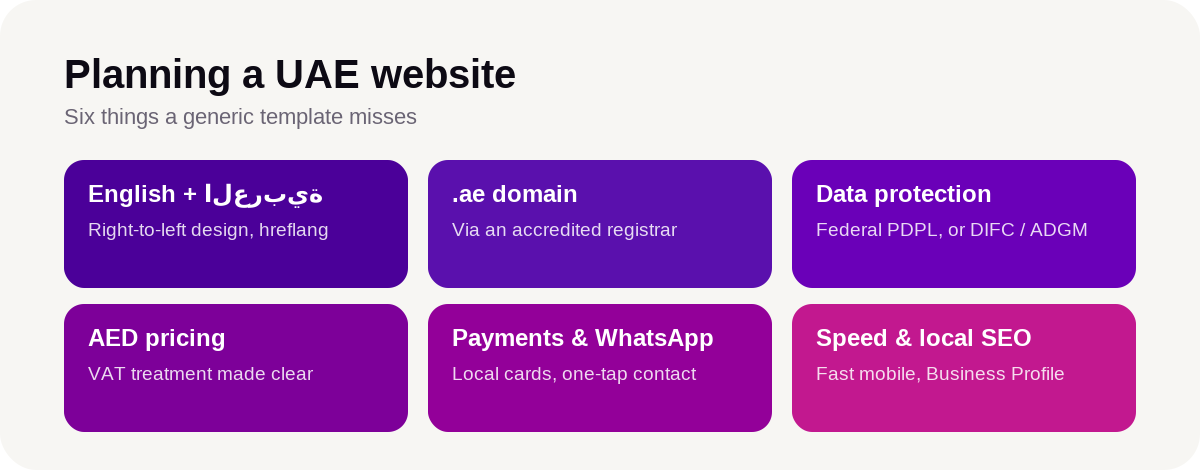
A UAE website has a few things to get right that a generic template ignores: English and Arabic, right-to-left layouts, .ae domains, data protection, VAT-inclusive pricing and fast mobile pages.
A website for a UAE business should usually be bilingual in English and Arabic, with Arabic designed as a proper right-to-left layout and linked through hreflang. Register a .ae domain through a TDRA-accredited registrar if you want a local address, follow the UAE's federal Personal Data Protection Law (or DIFC/ADGM rules in those free zones) for forms and cookies, show prices clearly with VAT treatment, support local payment and WhatsApp contact, and make mobile pages fast.
Plan Arabic as a full right-to-left design, not a mirrored afterthought.
Use hreflang to connect English and Arabic versions of each page.
.ae domains are registered through TDRA-accredited registrars.
Onshore UAE businesses fall under the federal PDPL; DIFC and ADGM have their own data laws.
The UAE is one of the most competitive online markets in the region. Customers compare businesses on their phones, expect fast pages, and often switch between English and Arabic. A generic template site misses several things a UAE business needs.
This guide covers what to plan for when building a website for a business in Dubai, Abu Dhabi or anywhere in the Emirates.
Six things to plan for a UAE website
1. English, Arabic or both?
Decide based on who you serve:
English-first works for many B2B and expat-focused businesses.
Bilingual English and Arabic widens your reach and often matters for consumer, government-facing and regional audiences.
If you add Arabic, plan it from the start.
2. Design Arabic as a right-to-left experience
Arabic isn't just translated text. Pages read right to left, so the layout should mirror: navigation, icons with direction, sliders and progress indicators.
Set the dir="rtl" and lang="ar" attributes correctly (W3C guidance).
Choose Arabic fonts that match your brand and stay readable at small sizes.
Check numbers, phone formats, dates and mixed English-Arabic text.
Have a native speaker review copy; machine translation reads poorly to customers.
3. Structure languages for SEO
Give each language its own URL, such as /en/ and /ar/.
Connect equivalent pages with hreflang tags so Google shows the right version (Google's guide).
Translate titles, descriptions and image alt text, not just body copy.
Don't automatically redirect visitors by IP; let them switch language easily.
4. Choose your domain
A .ae domain signals a local business. The .ae namespace is run by the .ae Domain Administration (aeDA) under the UAE's Telecommunications and Digital Government Regulatory Authority (IANA record), and you register through an accredited registrar. Some zones, such as gov.ae, have extra eligibility rules. Many regional businesses also hold the .com version.
Whatever you choose, register it in your company's name, not your agency's.
5. Data protection, forms and cookies
The UAE's federal Personal Data Protection Law (Federal Decree-Law No. 45 of 2021) took effect in January 2022 and applies to onshore businesses; the DIFC and ADGM free zones have their own data protection laws (summary by Clyde & Co).
For your website, that usually means:
A clear privacy policy in the languages you publish
Collecting only the data you need in forms
Explaining why you collect it and how to contact you about it
A considered approach to cookies and analytics
Take legal advice on what applies to your business.
6. Prices, VAT and payments
The UAE has a 5% standard VAT rate (u.ae). Make it clear whether prices include VAT.
Show prices in AED for local customers.
Choose a payment gateway that supports local cards and AED settlement, and test the full checkout on mobile.
Offer WhatsApp and click-to-call; many customers prefer them to forms.
7. Speed and mobile
UAE customers expect fast, polished mobile experiences.
Host on infrastructure with good performance in the region, or behind a global CDN.
Optimise images and fonts, especially Arabic web fonts, which can be large.
Test with Google PageSpeed Insights or our free website checker.
8. Local SEO and AI search
Create and complete your Google Business Profile with accurate categories, hours and photos. See our Business Profile checklist.
Use LocalBusiness schema with your UAE address. Our guide to schema markup explains how.
Keep your business details consistent across directories and social profiles.
Arabic designed right-to-left, reviewed by a native speaker
Separate URLs and hreflang for each language
Domain registered in the company's name
Privacy policy and forms reviewed for data protection
Prices in AED with VAT treatment clear
Payment gateway tested on mobile
WhatsApp and click-to-call on every page
Google Business Profile and LocalBusiness schema in place
The bottom line
A strong UAE website is bilingual where it matters, designed properly for right-to-left reading, clear on prices and data, and fast on mobile. Plan those from the start and you avoid expensive rework later.
It depends on your audience. Many UAE business sites are English-first, but adding Arabic widens your reach and can matter for government, consumer and regional audiences. If you add it, design it properly for right-to-left reading.
How do I register a .ae domain?
+
Through a registrar accredited by the .ae Domain Administration (aeDA), which operates under the UAE's Telecommunications and Digital Government Regulatory Authority (TDRA). Some second-level zones, such as gov.ae, have extra eligibility rules.
Which data protection law applies to my UAE website?
+
Businesses onshore in the UAE fall under Federal Decree-Law No. 45 of 2021 on the Protection of Personal Data. Companies in the DIFC and ADGM free zones follow those zones' own data protection laws. Take legal advice for your situation.
Should prices on my website include VAT?
+
The UAE has a standard VAT rate of 5%. Make it clear whether displayed prices include VAT, and follow the Federal Tax Authority's rules for tax invoices.
Can an agency outside the UAE build my website?
+
Yes. Many UAE businesses work with agencies abroad. Make sure they understand bilingual design, local expectations and your legal requirements, and keep your domain and hosting accounts in your company's name.
Articles are written and reviewed by the Incinc Media team, the people who plan, design, build and market websites, apps and campaigns for businesses from our head office in Mumbai and our branch offices in Faridabad and Greater Noida. We write about the questions clients ask us every week.
We've built websites for businesses in the UAE. Tell us your audience and languages, and we'll suggest the right structure and send a written proposal.
Outsourcing a website to India can work brilliantly or painfully. The difference is rarely talent. It's scope, communication, ownership and process. Here's how to set it up properly.
When your agency is in another country, the contract does more work. Here's a clause-by-clause checklist for scope, payments, ownership, data, accounts and what happens if things go wrong.