How to Write Product Descriptions That Sell (and Rank)
A product page has seconds to convince someone who can't touch the product. Here's a simple structure for descriptions that answer questions, build trust and help your products get found.
Good product descriptions lead with the main benefit for a specific buyer, then give scannable details: what it is, who it's for, key features as benefits, specifications, size or fit, materials, care, what's in the box, delivery and returns. Answer the questions that stop people buying, write in plain language using the words customers search, keep text unique for each product, and include the details Indian rules require for packaged goods, such as MRP, net quantity, manufacturer or importer and country of origin.
Lead with the main benefit for a specific buyer, not a list of features.
Make details scannable: bullets for features, a table for specifications.
Answer objections: size, fit, compatibility, care, delivery and returns.
Write unique text per product and include India's required declarations.
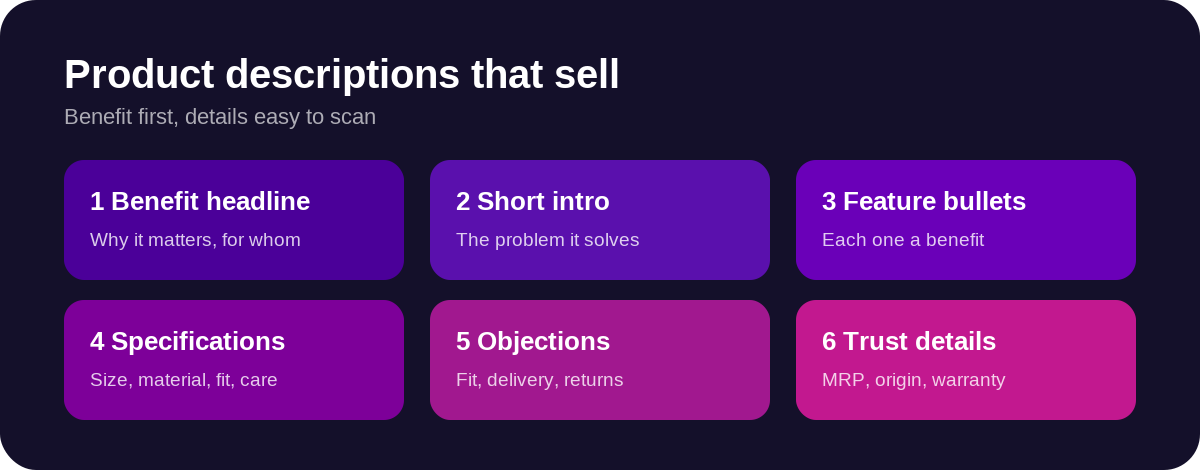
Product descriptions that sell lead with the main benefit for a specific buyer, then make the details easy to scan: what it is, who it's for, key features as benefits, specifications, size, materials, care, delivery and returns. They answer the questions that stop people buying, use the words customers search, and are unique for every product.
Online shoppers can't touch, try or ask a salesperson. The description and photos have to do that job. Here's a structure that works for most stores.
Anatomy of a product description
1. Know who you're writing for
Before writing, answer:
Who buys this, and for what situation? (A gift, daily use, a business, a special occasion.)
What do they compare it with?
What would stop them buying? (Size, quality, delivery time, returns.)
Write for that one buyer, in their language, rather than for everyone.
2. Lead with the benefit
The first sentence should say why the product matters, not repeat the title.
Feature-led
Benefit-led
"Stainless steel bottle, 1 litre, double wall."
"Keeps water cold through a full working day, in a 1-litre bottle that fits most car cup holders."
"100% cotton kurta."
"A breathable cotton kurta that stays comfortable through long summer days."
Then back the benefit with the feature that makes it true.
3. Make the details scannable
3 to 6 bullets for key features, each written as a benefit.
A specifications table for size, weight, material, colour, capacity and compatibility.
Size or fit guidance: how it fits, who it suits, how to measure.
Care instructions and what's in the box.
Most shoppers scan. Short paragraphs, bullets and tables help them find what they need.
4. Answer the questions that stop people buying
Add short answers to common doubts:
Will it fit or work with what I have?
How is it different from the cheaper option?
How long does delivery take, and can I return it?
Is it genuine, and is there a warranty?
Collect these from customer messages, reviews and returns. An FAQ under the description works well.
5. Help it get found
Use the words customers search: product type, material, size, use and audience, in the title and first sentence.
Keep each description unique. Copying the manufacturer's text doesn't help you stand out or rank.
Avoid promotional claims in feed descriptions. Google Merchant Center's product data specification says not to include promotional text such as "free shipping", all capital letters or links to your store. It suggests around 500 to 1,000 characters, with a maximum of 5,000, and the description should match your landing page.
Add Product structured data so search engines understand price, availability and reviews. Google's merchant listing guide explains what to include.
6. Include the details Indian rules require
For packaged goods sold online, the Legal Metrology (Packaged Commodities) Rules apply to e-commerce, as India Briefing explains. Product pages should show declarations such as MRP, net quantity, manufacturer or importer name and address, and country of origin. Rules have been updated over time, so confirm the current requirements for your category.
7. Back it up with photos and proof
Descriptions and images work together. Show what the text promises: scale, details, the product in use. See our product photography checklist. Add genuine reviews and ratings where your platform supports them.
A simple template
Headline: [Product] that [main benefit] for [buyer/use]
Intro (1-2 sentences): the problem it solves and why this product
Key features (3-6 bullets): feature -> benefit
Specifications: size, weight, material, colour, capacity, compatibility
Fit / sizing guidance:
Care instructions:
In the box:
Delivery, returns and warranty:
FAQs (2-4):
Required declarations: MRP, net quantity, manufacturer/importer, country of origin
The bottom line
Write for one buyer, lead with the benefit, make details scannable, answer objections, use the words people search and keep every description unique. Add the declarations Indian rules require and pair the text with clear photos.
Long enough to answer a buyer's questions. Many stores use a short benefit-led intro plus bullets and a specifications table. For Google Merchant Center, Google suggests around 500 to 1,000 characters, with a maximum of 5,000.
Can I copy the manufacturer's description?
+
It's better not to. Many sellers use the same text, so it doesn't help you stand out or rank. Rewrite it for your buyers, adding your own photos, sizing advice and answers to common questions.
Should product descriptions include keywords?
+
Yes, naturally. Use the words customers actually search, such as the product type, material, size and use, in the title, first sentence and specs. Avoid stuffing.
What must product pages show in India?
+
Packaged goods sold online must display declarations such as MRP, net quantity, manufacturer or importer details and country of origin under the Legal Metrology (Packaged Commodities) Rules. Check the current rules for your product category.
Can I use AI to write product descriptions?
+
As a first draft, yes, but check every fact and edit for your brand voice. Google Merchant Center asks merchants to use a separate structured description attribute for AI-generated descriptions.
Articles are written and reviewed by the Incinc Media team, the people who plan, design, build and market websites, apps and campaigns for businesses from our head office in Mumbai and our branch offices in Faridabad and Greater Noida. We write about the questions clients ask us every week.
We write product descriptions, shoot product photos and build product pages that answer buyers' questions and are ready for search and Google Shopping.
Shoppers can't touch your product, so your photos do the selling. Here's the shot list, setup and image rules to follow for your website, marketplaces and Google Shopping.
Setting up Shopify in India has a few steps that global guides skip: Shopify Payments isn't available, GST settings need manual review, and invoices need an app. Here's the full checklist, in order.
The build is only part of an online store's cost. Payment fees, platform charges, apps, shipping tools and marketing decide whether the store makes money. Here's the full picture before you commit.
Read
What we do
Everything your brand needs, under one roof.
Technology, creative production and digital marketing from one in-house team, with offices in Mumbai, Faridabad and Greater Noida.