How Much Does an E-commerce Website Cost in India? Setup, Fees and Running Costs
The build is only part of an online store's cost. Payment fees, platform charges, apps, shipping tools and marketing decide whether the store makes money. Here's the full picture before you commit.
An e-commerce website in India costs a one-time build (platform setup, design, catalogue, payments, shipping and testing) plus ongoing costs that scale with sales: payment gateway fees (Razorpay's standard rate is 2% on most domestic methods plus 18% GST on the fee), platform plans and transaction fees if you use Shopify, apps or extensions, hosting for WooCommerce or custom builds, shipping and courier charges, and maintenance. Estimate total cost at your expected monthly order volume, not just the build price.
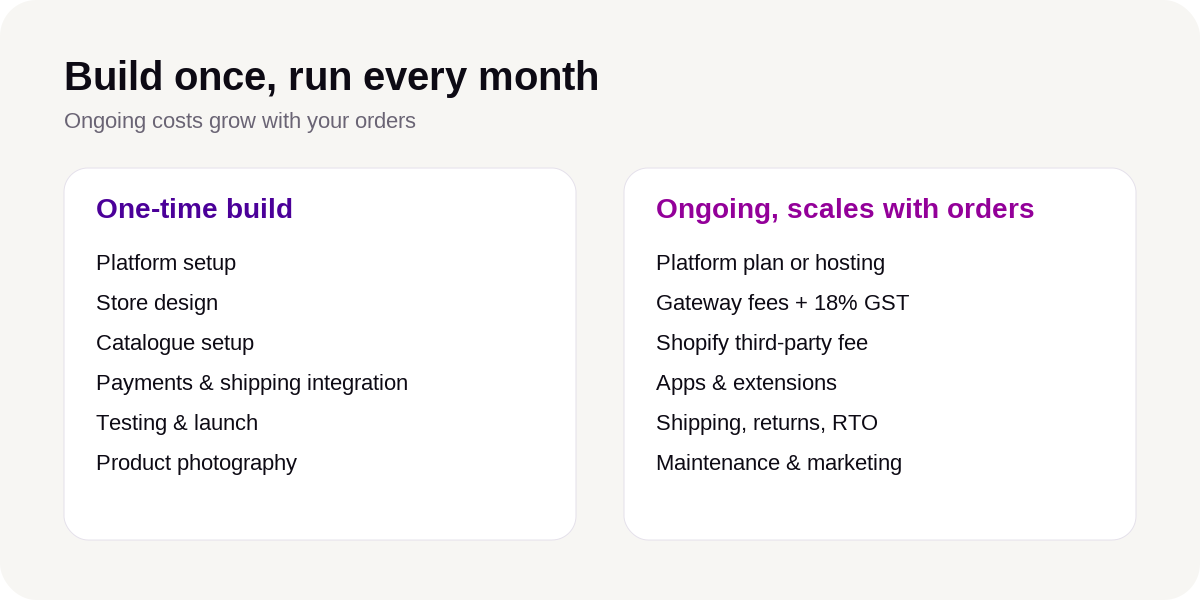
Separate one-time build costs from costs that grow with every order.
Payment gateway fees apply on any platform; Shopify adds its own fee on third-party gateways in India.
Catalogue size and product data quality often decide setup time more than design does.
Budget for photography and launch marketing: a store nobody sees sells nothing.
An online store is a different kind of website. A brochure site mostly costs money to build; a store costs money every time it sells. Payment fees, platform charges, shipping and apps scale with your orders. So the right question isn't only "how much to build?" but "what will it cost to run at the sales we expect?"
This guide breaks down both, for Indian businesses selling online in 2026.
The two kinds of cost
One-time (build)
Ongoing (run)
Platform setup and configuration
Platform plan (if Shopify or a SaaS platform)
Store design and theme customisation
Payment gateway fees on every online payment
Catalogue setup: products, variants, collections
Shopify's extra fee on third-party gateway payments
Payment gateway and shipping integration
Apps, extensions and licences
Policies, legal pages, tax settings
Hosting (WooCommerce or custom)
Testing and launch
Shipping, packaging and courier charges
Product photography
Maintenance, updates and support
Marketing to bring in customers
Build once, run every month
What drives the build cost
Platform choice
Shopify: quickest to launch, hosting and security included, monthly plan fee. Good for most D2C brands starting out.
WooCommerce: free plugin on WordPress, full control, no platform commission, but you manage hosting and updates.
Custom build: for marketplaces, complex B2B pricing, unusual ordering flows or deep ERP integration.
A customised theme is faster and cheaper; a custom design costs more but can make the brand and product pages far more distinctive. Product and collection pages matter most: that's where buying decisions happen.
Catalogue size and data quality
Setting up 20 products with clean data is quick. Setting up 2,000 products with variants, sizes, colours and inconsistent spreadsheets takes real time. Good product data (titles, descriptions, specifications, weights for shipping, HSN codes for invoicing) speeds up the build and improves SEO.
Features and integrations
Costs rise with features like:
Cash on delivery rules and pincode serviceability checks
Courier aggregator integration and automated shipping labels
Wholesale or B2B pricing, minimum order quantities
Every online payment carries a gateway fee. Razorpay's published standard pricing, for example, is 2% per transaction for most domestic methods (cards, UPI, net banking, wallets), with higher rates for international cards, Amex and EMI, and 18% GST on the fee (Razorpay). Other gateways price differently, and larger merchants can often negotiate.
Platform fees (Shopify)
Shopify charges a monthly plan fee (current India pricing) with GST. Because Shopify Payments isn't available in India, stores use third-party gateways, and Shopify adds its own transaction fee on those payments, which is lower on higher plans (explained by Razorpay). Manual methods like COD are generally exempt.
Apps and extensions
Reviews, upsells, advanced filters, subscriptions and notifications often come from paid apps or extensions, many billed monthly in US dollars. They add up quickly; install only what earns its keep.
Shipping
Courier charges depend on weight, size, distance and COD. Returns and failed COD deliveries are real costs for many Indian stores; factor them into pricing.
Maintenance
Hosted platforms need less technical maintenance, but every store needs someone to update products, test checkout, fix issues and keep apps compatible. WooCommerce and custom stores also need updates, backups and security monitoring.
A simple way to estimate your monthly running cost
Fill this in for each platform you're considering:
Line
How to estimate
Platform plan
Monthly plan price + 18% GST (Shopify) or hosting cost (WooCommerce/custom)
Gateway fees
Expected online-paid sales × gateway rate, + 18% GST on the fee
Shopify third-party fee
Expected online-paid sales × your plan's rate (Shopify only)
Apps / extensions
Sum of subscriptions you'll actually use
Shipping
Orders × average shipping cost, plus an allowance for returns and RTO
Maintenance
Your support plan or in-house time
Do this at today's sales and at the sales you expect a year from now. A setup that's cheapest at 50 orders a month may not be cheapest at 2,000.
Don't forget the costs outside the website
Marketing. A new store needs traffic: ads, social media, influencers, SEO. Budget for launch marketing from the start.
Packaging and fulfilment. Boxes, labels and the time to pack orders.
Customer service. Someone needs to answer WhatsApp, email and calls about orders and returns.
Compliance. GST registration and invoicing, return and refund policies, and the consumer-protection requirements that apply to e-commerce sellers. A chartered accountant can advise on your specific case.
Common mistakes
Choosing a platform on build price alone, without modelling fees at expected sales.
Too many apps at launch, slowing the store and adding monthly bills.
Poor product photos and thin descriptions, which no design can rescue.
Ignoring mobile checkout. Most Indian shoppers buy on phones; test checkout on a mid-range Android device on mobile data.
No plan for COD and returns, which can quietly erase margins.
The bottom line
An e-commerce website's cost is a build budget plus a running cost that grows with every order. Pick the platform by modelling total cost at your expected volume, invest in product photos and data, and keep marketing in the plan from day one.
What is the cheapest way to start selling online in India?
+
For a small catalogue, a hosted platform like Shopify on its entry plan, a free or low-cost theme and a standard payment gateway is usually the quickest low-cost start. Marketplaces like Amazon or Flipkart are another option, with their own commissions and rules.
Do I need GST registration to sell online in India?
+
E-commerce sellers often need GST registration, particularly when selling through marketplaces or across states. The rules have thresholds and exceptions, so confirm your situation with a chartered accountant before launch.
How much do payment gateways charge in India?
+
It varies by gateway and payment method. Razorpay's published standard pricing is 2% per transaction for most domestic methods (cards, UPI, net banking, wallets), with higher rates for international cards, Amex and EMI, plus 18% GST on the fee. High-volume merchants can often negotiate.
Should I build a custom e-commerce website?
+
Custom builds make sense for unusual business models (multi-vendor marketplaces, complex B2B pricing, location-based ordering) or when platform fees become significant at high volume. For most new stores, Shopify or WooCommerce is faster and cheaper.
How long does it take to launch an online store?
+
A store on a customised theme with a modest catalogue can launch in a few weeks once products, photos and policies are ready. Custom designs, large catalogues and integrations take longer.
Articles are written and reviewed by the Incinc Media team, the people who plan, design, build and market websites, apps and campaigns for businesses from our head office in Mumbai and our branch offices in Faridabad and Greater Noida. We write about the questions clients ask us every week.
We'll map your catalogue, payments and shipping, recommend the right platform and give you a clear estimate of both the build and the monthly running cost.
Both platforms run thousands of successful Indian stores. The right one depends on your team, catalogue and growth plans, and on fees many sellers don't notice until their first statement.
Two quotes for 'a website' can differ by ten times, and both can be fair. Here's what actually drives the price, what you'll pay every year after launch, and how to compare quotes properly.