

SEO & AI Search · 5 min read
How to Make Your Website AI-Search Friendly: A Practical Checklist
AI answers pull from websites they can crawl, understand and trust. Here's what to check on your own site, what genuinely helps, and what's hype.
Read
AI answers are changing how people search, and a wave of new acronyms has followed. Here's what SEO, AEO and GEO really mean, what has changed, and what hasn't.
Quick answer
SEO (search engine optimisation) helps your pages get found and ranked in search results. AEO (answer engine optimisation) shapes content so search features and assistants can lift a direct answer from it. GEO (generative engine optimisation) aims to get your content used and cited inside AI-generated answers such as Google AI Overviews, ChatGPT search or Perplexity. They overlap heavily: crawlable pages, clear answers, accurate facts and a trustworthy brand are the foundation of all three.
A customer who once typed "best CA firm near Vikhroli" into Google might now ask ChatGPT, Gemini or Perplexity, or read Google's AI Overview without scrolling further. Marketers have responded with new labels: AEO and GEO. Some say SEO is finished. It isn't. But the way search works has genuinely shifted, and it's worth understanding what that means for a business website.
| Term | Stands for | Goal | Where it shows up |
|---|---|---|---|
| SEO | Search engine optimisation | Get pages found, indexed and ranked | Google and Bing results, Maps, image and video results |
| AEO | Answer engine optimisation | Make content easy to lift as a direct answer | Featured snippets, "People also ask", voice assistants, AI answers |
| GEO | Generative engine optimisation | Get content used and cited in AI-generated answers | Google AI Overviews and AI Mode, ChatGPT search, Perplexity, Copilot, Gemini |
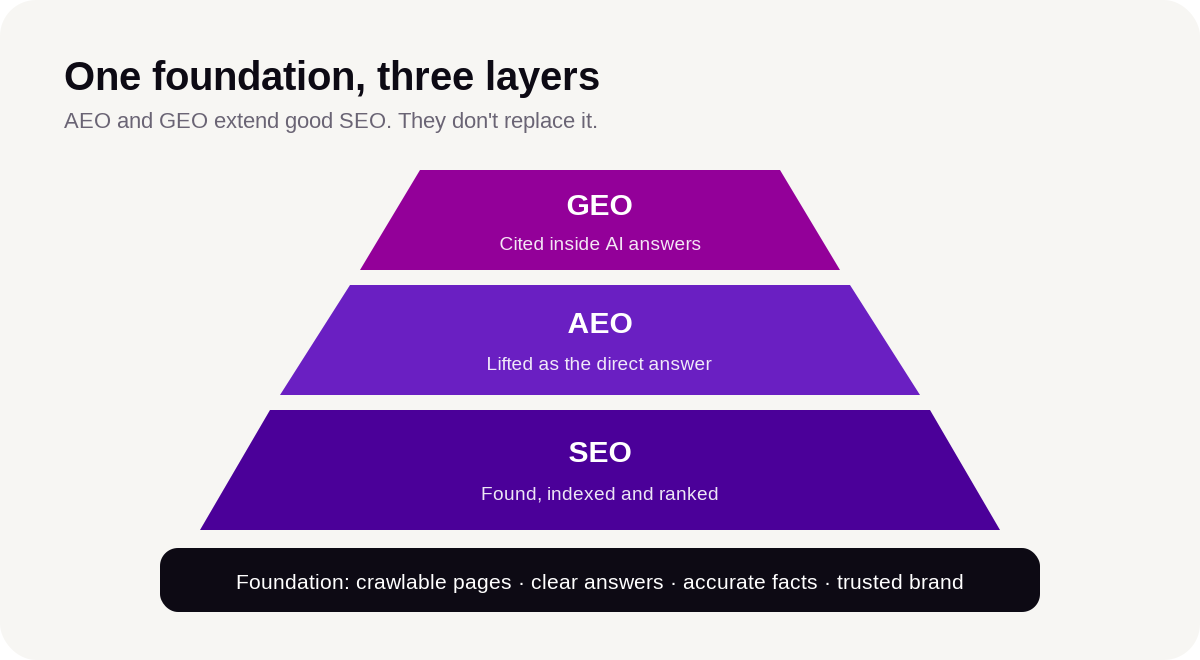
Think of them as layers. SEO gets you into the library. AEO makes your page the clearest answer on the shelf. GEO makes it the source an AI assistant chooses to quote.
Search engine optimisation is everything that helps search engines crawl, understand and rank your pages: a fast, mobile-friendly site, clear page titles and headings, helpful content that matches what people search for, internal links, structured data, and a reputation that makes other sites link to you.
SEO hasn't stopped mattering. Google's own guidance on AI features says that the same fundamentals apply: pages must be crawlable and indexable, findable through internal links, and offer a good page experience. If search engines can't access or understand your pages, no AI layer on top will fix that.
Answer engine optimisation focuses on the answer, not just the ranking. It grew out of featured snippets and voice search, where a single answer is read out or shown at the top.
AEO in practice means:
None of this is a trick. It's simply good writing for busy readers, and it makes content easier for machines to extract accurately.
Generative engine optimisation was named in a research paper, "GEO: Generative Engine Optimization", by researchers from Princeton University, IIT Delhi and others, accepted at the KDD 2024 conference. The authors tested ways content creators could improve how visible their content is in AI-generated answers and found that strategies such as adding citations, quotations and statistics from credible sources could improve visibility, with results varying by subject area.
In plain terms, GEO asks: when an AI system assembles an answer, will it find, trust and cite your page? That depends on:
AI search experiences generally run a web search behind the scenes and then summarise what they find. Google describes AI Overviews and AI Mode as potentially using a "query fan-out" technique, running several related searches across subtopics to build a response. So the pages that rank well and answer specific sub-questions clearly are the ones most likely to be drawn on.
For ChatGPT search, OpenAI documents a dedicated crawler, OAI-SearchBot, that's used to surface websites in search results; sites that block it in robots.txt won't be shown in ChatGPT search answers. That's separate from GPTBot, which relates to model training. Check OpenAI's crawler documentation for current details.
Strip away the acronyms and the essentials look familiar:
Here's the difference in practice, using a question a Mumbai interior designer might want to rank for.
Before (hard to extract): a page titled "Our Services" that opens with three paragraphs about the founder's passion for design, mentions pricing in passing on the fifth screen, and never states which areas the studio covers.
After (answer-first):
Both a reader and an AI system can now answer "what does it cost and what affects the price?" from the page in seconds, and the page has many specific facts worth citing.
For a local business, AI answers often look like a short list of recommended providers with a sentence about each. To give AI systems accurate material to work with:
All three, but in order. Get your SEO foundations right first; nothing else works without them. Then write content in an answer-first way (AEO). Then strengthen the signals that make AI systems confident enough to cite you (GEO): accuracy, sources, authorship and a consistent brand.
If you'd like a clear picture of where your website stands, our SEO team can run a technical and content audit that covers classic search and AI-search readiness, with fixes ranked by impact. To run the basics yourself first, work through our technical SEO checklist and the AI-search friendly website checklist, and if you're hiring, read how to choose an SEO company in Mumbai.
For what Google's AI features mean for your traffic specifically, read how AI Overviews and AI Mode affect SEO.
No. Google's AI features draw on its search index and ranking systems, and AI assistants with web search still need to find and read pages. What's changing is how results are presented and how often people click. Strong SEO fundamentals remain the entry ticket.
Generative engine optimisation is the practice of making your content easy for AI systems to find, understand, trust and cite when they generate an answer. The term was popularised by a 2023 research paper from Princeton and collaborators.
Allow OpenAI's search crawler (OAI-SearchBot) in your robots.txt, make sure your pages are crawlable and indexable, and publish clear, accurate, well-structured content about what you do. There is no paid placement or guaranteed method for organic results.
Google states that no special structured data is required to appear in AI features. Structured data is still useful because it helps search engines understand your pages and can enable rich results.
Google includes AI Overviews and AI Mode clicks within overall Search Console performance data. Bing Webmaster Tools has added AI performance reporting for Copilot citations. For other assistants, look at referral traffic in analytics.
Written by
Articles are written and reviewed by the Incinc Media team, the people who plan, design, build and market websites, apps and campaigns for businesses from our head office in Mumbai and our branch offices in Faridabad and Greater Noida. We write about the questions clients ask us every week.
Want to know how visible you are in search and AI answers?
We'll audit your website's technical SEO, content and AI-search readiness, and give you a prioritised list of fixes.
SEO & AI Search · 5 min read
AI answers pull from websites they can crawl, understand and trust. Here's what to check on your own site, what genuinely helps, and what's hype.
SEO & AI Search · 2 min read
You don't need to be an expert to get the fundamentals right. These basics help customers find your services on Google.

SEO & AI Search · 2 min read
For many customers, your Google listing is the first thing they see. A complete, active profile makes it easier to be found and chosen.
Start a project
Whether you need a digital product, a creative campaign or a complete digital transformation, let's build something meaningful together.
Or call +91 81081 14819·mail@incincmedia.com