Shopify vs WooCommerce for Indian Businesses: Costs, Fees and Which to Choose
Both platforms run thousands of successful Indian stores. The right one depends on your team, catalogue and growth plans, and on fees many sellers don't notice until their first statement.
Choose Shopify if you want to launch quickly, avoid managing hosting and updates, and are comfortable paying a monthly plan fee plus Shopify's extra transaction fee on third-party gateways (Shopify Payments isn't available in India). Choose WooCommerce if you want full control, no platform commission and freedom to customise, and you have a developer or agency to manage hosting, security and updates.
Shopify: faster launch, less maintenance, monthly plan fee plus a plan-based fee on third-party gateway payments in India.
WooCommerce: the plugin is free and there's no platform commission, but hosting, security and updates are your responsibility.
Both work with Indian payment gateways for UPI, cards and net banking, which charge their own fees plus 18% GST.
Compare total yearly cost at your expected order volume, not just the monthly price.
If you're starting an online store in India, the platform question usually comes down to two names: Shopify and WooCommerce. Both power successful stores. Both work with Indian payment gateways and UPI. The difference lies in who runs the technology, how fees are charged, and how much control you need.
This guide compares them for Indian businesses specifically, including the fees that only show up once orders start coming in.
Quick comparison
Shopify
WooCommerce
What it is
Hosted, subscription e-commerce platform
Free, open-source plugin for WordPress
Hosting & security
Included and managed by Shopify
You arrange hosting; you or your agency manage security and updates
Yes, on third-party gateway payments; lower on higher plans
No platform commission
Payment gateways in India
Third-party gateways (Shopify Payments isn't available in India)
Any gateway with a WooCommerce plugin
Speed to launch
Fast
Moderate; depends on setup
Customisation
Themes and apps; deeper changes need Shopify development skills
Almost unlimited with WordPress development
Ongoing maintenance
Low
Moderate to high
Best for
Brands that want to sell quickly with a small team
Businesses that want control, content-heavy stores and custom flows
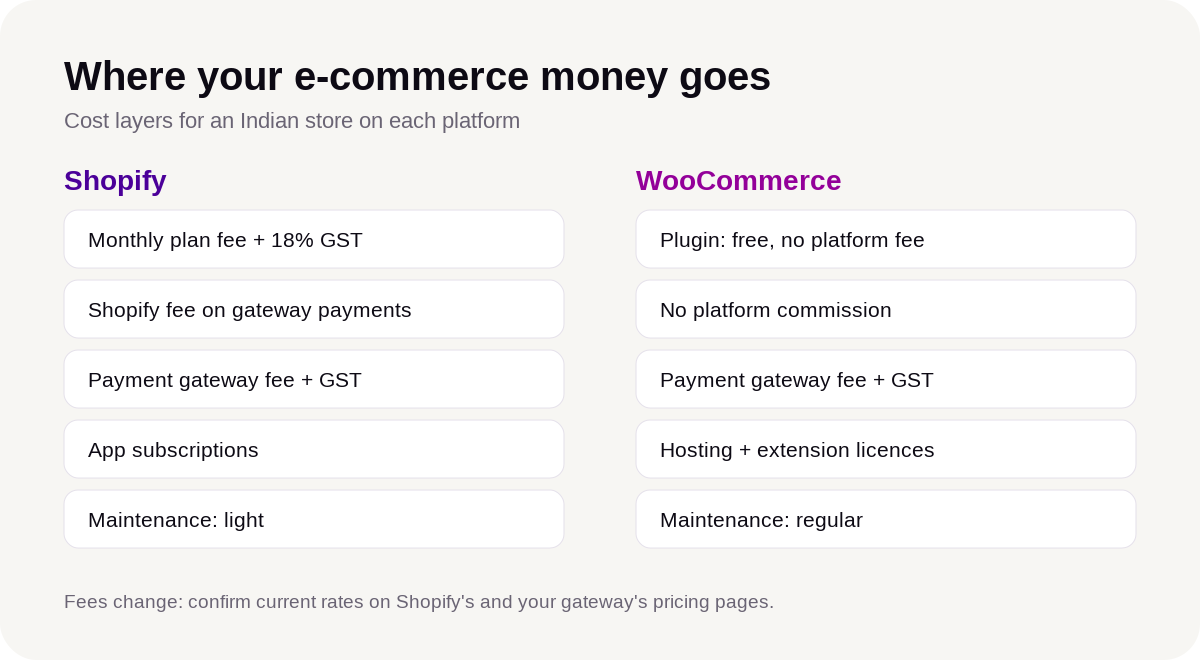
Where your e-commerce money goes on each platform
How Shopify works in India
Shopify is a hosted platform. You pay a monthly subscription, and Shopify handles servers, security, checkout infrastructure and updates. You choose a theme, add apps for extra features and manage everything from one dashboard.
Shopify fees Indian sellers should know
Plan fee. Shopify sells plans in India with INR pricing, cheaper per month when billed yearly. At the time of writing, plans ranged from Basic through Grow and Advanced up to Plus. Check the current prices before budgeting, and note that 18% GST applies on top.
Third-party transaction fee. Shopify Payments isn't available in India, so Indian stores use gateways such as Razorpay, PayU or Cashfree. On those payments, Shopify charges its own transaction fee that is highest on the Basic plan and reduces on higher plans. Razorpay's explainer walks through how this stacks with gateway charges. Manual methods like cash on delivery are generally exempt.
Gateway fee. Charged by your payment gateway, separate from Shopify.
Apps. Many features (reviews, advanced filters, subscriptions, WhatsApp notifications) come from apps with their own monthly subscriptions, often priced in US dollars.
Theme. Free themes exist; premium themes are a one-time purchase.
Where Shopify shines: launching quickly, a reliable checkout, minimal technical upkeep, and a large app ecosystem. If your team is small and you'd rather focus on products and marketing, that's worth paying for.
Where it's limiting: fixed URL structures, extra fees on every gateway payment, and some customisations that need specialist Shopify development or paid apps.
How WooCommerce works in India
WooCommerce turns a WordPress website into a store. The WooCommerce plugin is free, and you own the entire installation on your own hosting.
WooCommerce costs Indian sellers should know
Hosting. You'll need reliable hosting sized for your traffic. Cheap shared hosting is a false economy for a store: slow pages lose sales.
Theme and extensions. Many are free; premium themes and extensions (for subscriptions, bookings, advanced shipping) are usually annual licences.
Payment gateway fee. Indian gateways offer WooCommerce plugins. You pay their transaction fee; there's no extra platform commission.
Maintenance. WordPress core, the theme and plugins need regular updates, backups and security monitoring. Budget for this, either with an agency or an in-house person.
Where WooCommerce shines: full ownership and control, no per-order platform fee, strong content and blogging (it's WordPress), and freedom to build custom checkout, pricing or B2B flows.
Where it's demanding: you're responsible for performance, security and compatibility between plugins. Without good maintenance, problems arrive at the worst time, usually during a sale.
Payment gateways and GST: the same on both
Whichever platform you choose, the payment gateway is a separate cost. As an example, Razorpay's published standard pricing is 2% per transaction for most domestic payment methods (cards, UPI, net banking, wallets), with higher rates for international cards, Amex and EMI, and 18% GST charged on the fee (source). Other gateways price differently, and high-volume merchants can often negotiate.
A worked example: how fees add up
Imagine a store doing a few hundred online-paid orders a month. To compare platforms fairly, add up for each:
Cost line
Shopify
WooCommerce
Platform plan (plus 18% GST)
Monthly plan fee
None
Shopify third-party fee
% of online-paid sales, by plan
None
Gateway fee (plus 18% GST)
% of online-paid sales
% of online-paid sales
Hosting
Included
Monthly or yearly hosting
Apps / extensions
App subscriptions
Extension licences
Maintenance
Light
Regular updates and monitoring
At low order volumes, Shopify's simplicity often wins. As online-paid revenue grows, the per-order platform fee becomes significant, which is why growing stores either move up Shopify's plans (lower fee) or consider WooCommerce or a custom build. Run the numbers at your expected volume a year from now, not today's.
Which should you choose? A simple decision guide
Choose Shopify if:
You want to launch within weeks with a small team
You'd rather not deal with hosting, security or updates
Your products and checkout are fairly standard
You value a large app ecosystem over deep customisation
Choose WooCommerce if:
You already run a WordPress website and want the store inside it
You need custom pricing, B2B ordering, or unusual product configurations
You want no platform commission on sales
You have an agency or developer for ongoing maintenance
Consider a custom build if your business model doesn't fit either: marketplaces with many sellers, location-based ordering, complex subscriptions or deep ERP integration.
Mistakes we see Indian sellers make
Ignoring the third-party transaction fee when picking a Shopify plan. Compare plans at your expected monthly sales.
Choosing the cheapest hosting for WooCommerce. A slow store loses customers, especially on mobile data.
Installing too many apps or plugins. Each one adds cost, slows the site and adds things that can break.
Not planning shipping and returns early. Courier integrations, COD rules and return policies affect your platform setup.
Neither platform is "best" for everyone. Shopify buys you speed and peace of mind for a monthly and per-order cost. WooCommerce gives you control and no platform commission in exchange for more responsibility. Decide on total yearly cost at your expected volume, the skills on your team, and how much you need to customise.
Yes, Shopify sells plans in India with INR pricing. However, Shopify Payments, its built-in payment processor, isn't available in India, so Indian stores use third-party gateways such as Razorpay, PayU or Cashfree.
Does Shopify charge a transaction fee in India?
+
When you use a third-party payment gateway, Shopify charges its own transaction fee on those payments, which is lower on higher plans. Your gateway's fees are charged separately. Manual methods such as cash on delivery are generally exempt. Check Shopify's current pricing page for the exact rates.
Is WooCommerce really free?
+
The WooCommerce plugin itself is free and open source. You still pay for a domain, hosting, any premium themes or extensions you choose, payment gateway fees, and development and maintenance.
Which is better for SEO, Shopify or WooCommerce?
+
Both can rank well. WooCommerce (on WordPress) offers more control over URLs and technical SEO; Shopify handles the technical basics automatically but uses fixed URL patterns such as /products/ and /collections/. Content quality and site speed matter more than the platform.
Can I move from Shopify to WooCommerce later, or the other way round?
+
Yes. Products, customers and orders can be migrated with tools or a developer, and URL redirects protect your search rankings. It's easier when the store is smaller, so it's worth choosing carefully upfront.
Articles are written and reviewed by the Incinc Media team, the people who plan, design, build and market websites, apps and campaigns for businesses from our head office in Mumbai and our branch offices in Faridabad and Greater Noida. We write about the questions clients ask us every week.
Two quotes for 'a website' can differ by ten times, and both can be fair. Here's what actually drives the price, what you'll pay every year after launch, and how to compare quotes properly.
Mumbai has hundreds of web agencies and freelancers. Here's how to shortlist, question and compare them so you end up with a website that works and a partner you can rely on.