How Much Does Website Development Cost in India in 2026? A Complete Breakdown
Two quotes for 'a website' can differ by ten times, and both can be fair. Here's what actually drives the price, what you'll pay every year after launch, and how to compare quotes properly.
Website development cost in India depends mainly on five things: the number of unique page designs, custom design versus a template, features and integrations (payments, bookings, logins), who creates the content, and ongoing running costs. Get itemised quotes for the same written scope, add 18% GST on Indian agency invoices, and budget separately for domain, hosting, maintenance and any platform or payment fees.
Price follows scope, not page count: features, integrations and content creation move the number most.
Compare quotes only against the same written scope, with deliverables, revisions and timeline spelled out.
Plan for yearly running costs (domain, hosting, maintenance, licences) from day one.
Ask who owns the domain, hosting account, source files and admin logins before you pay.
Ask five agencies what a website costs and you may get five very different numbers. That doesn't automatically mean someone is overcharging. "A website" can mean a three-page brochure on a template, or a custom-designed platform with logins, payments and integrations. The price follows the scope.
This guide breaks down what actually drives website development cost in India in 2026, the costs you'll keep paying after launch, and how to compare quotes so you're judging like for like. We've written it from the questions business owners ask us most often when they start a website project with Incinc Media.
The short answer
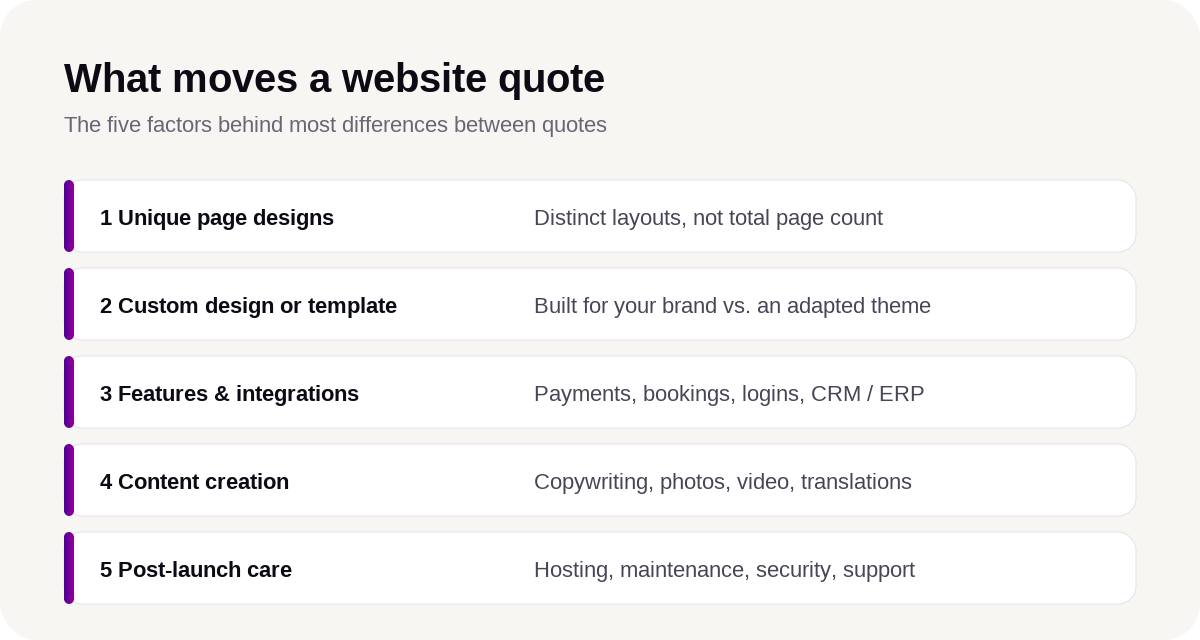
Website cost depends on how much needs to be designed, built and written, and what the site has to connect to. Five factors explain most of the difference between quotes:
Unique page designs, not total pages. Fifty product pages that share one layout cost less to design than ten pages that each need a different layout.
Custom design or a template. A custom design is created for your brand and content; a template adapts an existing theme.
Features and integrations: enquiry forms and WhatsApp buttons are simple; payments, bookings, customer logins, CRM or ERP connections, calculators and multilingual content add real work.
Content: whether you supply final text, photos and videos, or the agency writes, shoots and edits them.
What happens after launch: hosting, maintenance, security updates, backups and support.
What moves a website quote up or down
What you are actually paying for
A professional website quote is mostly people's time. Understanding the stages helps you see why two quotes differ.
1. Discovery and planning
Before design starts, someone needs to understand your business, your customers and what the site must achieve: more enquiries, dealer leads, job applications, online sales. The output is a sitemap and a content plan. Skipping this step is the most common reason websites get redesigned again within two years.
2. UX and visual design
Designers create layouts for desktop and mobile. Custom design costs more because each key page is designed for your content rather than squeezed into a theme. Many visitors to Indian business websites arrive on a phone (your analytics will show your exact split), so mobile layouts deserve as much attention as desktop.
3. Development
Developers turn designs into a working site, either hand-coded or on a content management system (CMS) such as WordPress, Shopify or a headless CMS. Features are where development time grows fastest. A simple enquiry form takes hours; a booking system with availability, payments and email confirmations can take weeks.
4. Content
Text, photos, videos, product descriptions and translations. If you provide final content, the price drops. If the agency writes copy, organises a photoshoot or produces a brand video, the price rises, and usually so does the quality of the final site.
5. SEO foundations, testing and launch
Clean URLs, page titles and descriptions, structured data, image optimisation, redirects from your old site, analytics and Search Console setup, plus testing across browsers and devices. Google's own SEO Starter Guide is a good reference for what basic SEO hygiene looks like. These tasks are invisible in a design mock-up, so they're often the first thing a cheap quote leaves out.
How scope changes the price
Here is how the same business might scope three very different websites. We've deliberately described the scope rather than quoting fixed rupee amounts, because the right figure depends on design depth, content and features, and any single number without a scope is misleading.
Scope level
Typical contents
What drives the cost
Starter presence
4 to 6 pages on a customised template, enquiry form, WhatsApp button, basic SEO
Template licence, content you supply, quick turnaround
Professional business site
8 to 20 pages, custom design, CMS, blog, service and industry pages, analytics and tracking
Custom design, page layouts, copywriting, SEO setup
Platform or online store
Custom design plus e-commerce, bookings, logins or integrations with CRM, ERP or payment gateways
Features, integrations, data migration, testing and security
A good agency should be able to tell you which row you're in, and why, after one conversation.
The costs that continue after launch
Many website budgets go wrong here. A website has running costs, and you should know them on day one.
Recurring cost
What it covers
Notes
Domain name
Your web address (such as .com or .in)
Renewed yearly; prices vary by registrar and extension. Register it in your own name (how to choose one).
Hosting
The server your site runs on
Shared, cloud or managed hosting. Faster, more reliable hosting costs more.
SSL certificate
The padlock and https://
Often free and included with modern hosting.
Maintenance
Updates, security patches, backups, small changes
Essential for CMS sites like WordPress.
Licences and apps
Premium themes, plugins, Shopify apps, fonts
Many are yearly subscriptions, often priced in dollars.
Business email
Email on your own domain
Usually charged per user per month.
E-commerce fees
Platform subscription and payment gateway charges
See below.
E-commerce: platform and payment fees
If you sell online, you'll also pay fees on every order. As an example of how these stack up for Indian stores:
Payment gateways. Razorpay's published standard pricing, explained on its own blog, is 2% per transaction for most domestic methods (cards, UPI, net banking, wallets), with higher rates for international cards, Amex and EMI, and 18% GST on the fee. Other gateways have their own pricing, and high-volume merchants can often negotiate.
Prices for third-party services change often. Always confirm the current figure on the provider's own pricing page before you budget.
How the platform affects cost
The technology a site is built on changes both the build price and the running cost. There's no universally "best" option; there's the right fit for how you'll use the site.
Platform
Good for
Build cost drivers
Running cost drivers
WordPress (template-based)
Small business sites, blogs
Theme customisation, plugins
Hosting, plugin licences, regular updates
WordPress (custom theme)
Content-rich business sites
Custom design and development
Hosting, maintenance, security
Shopify
Online stores that want to launch fast
Theme setup, apps, catalogue
Monthly plan, app subscriptions, transaction fees
Custom-coded / headless
Performance-critical sites, platforms, unusual features
Bespoke development
Hosting, developer support for changes
Website builders (DIY)
Very small or temporary sites
Your own time
Monthly subscription; limited flexibility
A practical rule: if your team will publish content often, prioritise an easy CMS. If speed, design freedom or custom features matter most, a custom or headless build may be worth the higher upfront cost.
Timeline and cost are linked
Rushed timelines cost more because they need more people working in parallel and leave less room for review. Very long timelines also cost more when projects stall waiting for content and decisions, and teams have to re-familiarise themselves. The most cost-efficient projects agree a realistic schedule upfront, with clear dates for your inputs (content, feedback and approvals) as well as the agency's deliverables.
Questions to ask before you sign
What exactly is included, and what is excluded?
How many design concepts and revision rounds are included?
Who writes the content, and who sources images?
Which SEO tasks are part of the launch (titles, descriptions, structured data, sitemap, redirects)?
What are the yearly running costs, and who pays each one?
Who owns the domain, hosting account, code and design files after the final payment?
What support is included after launch, and for how long?
GST on website development
In India, website and software development services generally attract 18% GST, commonly under SAC code 998314 (reference). When you compare quotes, check whether each figure is "plus GST" or "inclusive of GST". A quote that looks cheaper may simply exclude tax. If your business is GST-registered, you can usually claim the input tax credit; your accountant can confirm.
Five ways to lower the cost without hurting results
Prepare your content early. Final text, logo files, photos and product data are the biggest cause of delays, and delays cost money.
Launch with what matters, then grow. Put must-have features in phase one; schedule "nice-to-haves" for later.
Reuse layouts. Ten service pages that share one strong template are cheaper and more consistent than ten unique designs.
Choose the platform for how you'll run the site. If your team will update content weekly, a good CMS pays for itself.
Ask for the yearly running cost in writing. A low build price with expensive plugins and hosting can cost more over three years.
Common mistakes we see
Comparing quotes with different scopes. One includes copywriting, SEO setup and training; another doesn't. Write the scope first.
Not owning your accounts. Your domain, hosting, Google Analytics and Search Console should be registered to your business, with the agency added as a user.
Forgetting mobile. Designing on a laptop and checking mobile last leads to slow, cramped pages for most of your visitors.
Launching without tracking. If you can't see which pages and channels produce enquiries, you can't improve them.
Skipping redirects when replacing an old site. Old URLs that disappear can lose rankings that took years to build.
How to get an accurate quote
Send every agency the same short brief:
What the website must achieve, in one or two sentences
Who it's for, and the three actions you want visitors to take
The pages you need, and any features (payments, bookings, logins, integrations)
What content you'll supply, and what you need created
A fair website price is one where the scope is written down, every line is explained, running costs are known upfront and you own the result. If two quotes differ wildly, compare their scopes before their totals. To map your own scope in two minutes, try our free website planner. If the platform itself is the open question, read custom website vs WordPress.
If you'd like a clear, itemised estimate for your business, talk to our website team. We'll tell you honestly which scope fits your goals, even if it's the smaller one.
Frequently asked questions
How much does a basic business website cost in India?
+
There's no single fair price, because 'basic' means different things. A few pages on a ready-made template with your own content costs far less than a custom-designed site with copywriting, photography and integrations. Ask for an itemised quote against a written scope so you can see exactly what you're paying for.
Is GST charged on website development in India?
+
Yes. Website and software development services are generally taxed at 18% GST in India (commonly classified under SAC 998314). A GST-registered agency will add it to the invoice; registered businesses can usually claim input tax credit. Confirm the treatment for your case with your accountant.
Why is a custom website more expensive than a template website?
+
A custom site is designed for your content, audience and brand from scratch, then built and tested page by page. A template site adapts an existing design. Templates are faster and cheaper but limit how distinctive and efficient the site can be.
What are the yearly costs after a website is launched?
+
Typical recurring costs are domain renewal, hosting, SSL (often included with hosting), maintenance and updates, paid plugins or app subscriptions, business email, and for online stores, platform and payment gateway fees.
Should I choose the cheapest website quote?
+
Only if it covers the same scope and quality. Cheap quotes often leave out content, SEO basics, revisions, testing, training or post-launch support, which then cost extra. Compare like for like.
Articles are written and reviewed by the Incinc Media team, the people who plan, design, build and market websites, apps and campaigns for businesses from our head office in Mumbai and our branch offices in Faridabad and Greater Noida. We write about the questions clients ask us every week.
Share what your website needs to do. We'll recommend the right scope, explain every line of the estimate and give you a fixed price before any work starts.
WordPress runs a huge share of the web, and custom builds power the fastest, most distinctive sites. The right choice depends on who edits the site, what it must do and how long it needs to last.
Mumbai has hundreds of web agencies and freelancers. Here's how to shortlist, question and compare them so you end up with a website that works and a partner you can rely on.
Both platforms run thousands of successful Indian stores. The right one depends on your team, catalogue and growth plans, and on fees many sellers don't notice until their first statement.
Read
Start a project
Telluswhat you'rebuilding.
Whether you need a digital product, a creative campaign or a complete digital transformation, let's build something meaningful together.