How to Calculate Advertising ROI: ROAS vs ROI, CPL and CAC Explained
A 4x ROAS can still lose money. Here's how to calculate the numbers that matter, from cost per lead to real profit, with a worked example you can copy.
Advertising ROI is (profit from ads minus total ad costs) divided by total ad costs. ROAS is revenue divided by ad spend, which ignores your margins, so a high ROAS can still lose money. Track cost per lead (spend divided by leads), lead-to-customer rate, customer acquisition cost (total cost divided by new customers), and gross profit per customer. Ads are profitable when gross profit per customer, ideally over the customer's lifetime, exceeds acquisition cost.
ROAS measures revenue; ROI measures profit. Decide with ROI.
Include every cost: ad spend, taxes, agency or tool fees and creative.
Your break-even ROAS depends on your gross margin.
Repeat customers change the maths; use lifetime value where it's real.
"We're getting a 4x ROAS" sounds great until you subtract product costs, delivery, platform fees, taxes and the agency. Then it can turn out to be a loss. The fix is to measure the right numbers in the right order.
This guide explains each metric, gives you the formulas, and walks through an example.
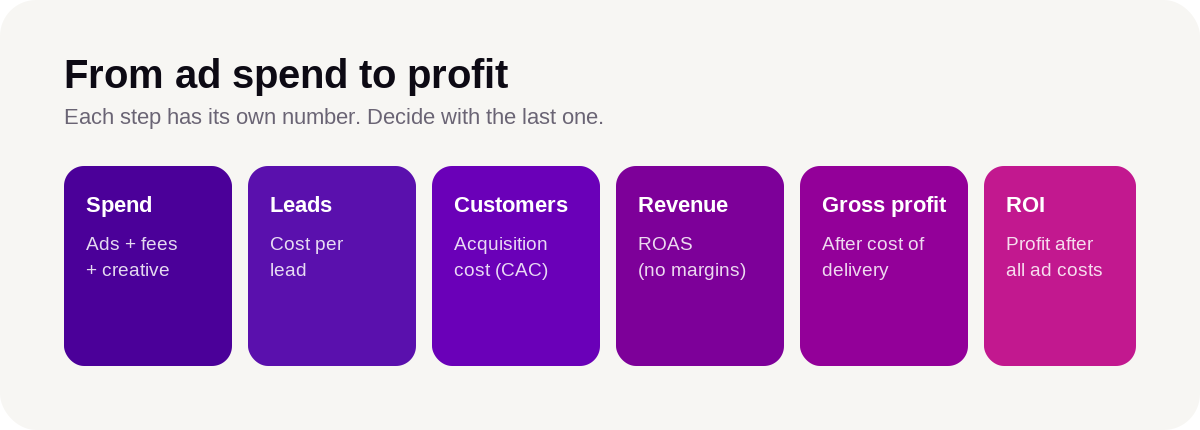
From spend to profit
The formulas
Metric
Formula
Tells you
Cost per lead (CPL)
Ad spend ÷ leads
How cheaply you get enquiries
Lead-to-customer rate
Customers ÷ leads
How good the leads and your sales follow-up are
Customer acquisition cost (CAC)
Total marketing cost ÷ new customers
What one customer costs you
ROAS
Revenue from ads ÷ ad spend
Revenue efficiency, ignoring margins
Gross profit
Revenue − cost of goods or delivery
What you actually keep from sales
ROI
(Gross profit − total ad costs) ÷ total ad costs
Whether ads made money
Break-even ROAS
1 ÷ gross margin
The minimum ROAS to not lose money
A worked example
The numbers below are illustrative, not benchmarks.
A service business spends ₹50,000 on ads in a month, plus ₹15,000 in management and creative costs, so total cost is ₹65,000.
Leads: 100, so cost per lead = ₹50,000 ÷ 100 = ₹500
Customers: 8, so lead-to-customer rate = 8%
CAC = ₹65,000 ÷ 8 = ₹8,125
Revenue: ₹2,40,000 (₹30,000 per customer), so ROAS = ₹2,40,000 ÷ ₹50,000 = 4.8
Gross margin: 40%, so gross profit = ₹96,000
ROI = (₹96,000 − ₹65,000) ÷ ₹65,000 = 0.48, or 48%
Break-even ROAS at a 40% margin is 1 ÷ 0.4 = 2.5, so a ROAS of 4.8 is comfortably profitable here. With a 15% margin, the same ROAS would lose money.
The costs people forget
Taxes on ad spend, where they apply to your invoices
Agency or freelancer fees
Creative: shoots, design, video editing
Tools: CRM, landing page builders, call tracking
Discounts and refunds
Sales time spent on leads that don't convert
Lifetime value changes the picture
If customers buy again or stay on a retainer, the first sale understates their value. Use customer lifetime value (average gross profit per customer over their relationship with you) when:
You have real repeat-purchase data
You can afford to wait for that profit to arrive
Don't use optimistic lifetime value to justify ads that lose money on every first sale unless you have the data and cash flow to back it.
How to track it properly
Track conversions in Google Ads, Meta and Google Analytics: forms, calls, WhatsApp clicks and purchases. See what to track in your marketing.
Record the source of every lead in a sheet or CRM.
Mark outcomes: contacted, qualified, won, lost, with the sale value.
Import offline conversions into ad platforms where possible, so they optimise for sales, not just leads.
Review monthly by channel and campaign.
Common mistakes
Judging ads by clicks or cost per lead alone
Using ROAS without knowing your margin
Ignoring sales follow-up, which often decides the lead-to-customer rate
Comparing channels with different attribution windows
Stopping campaigns after a few days, before there's enough data
The bottom line
Use ROAS for a quick read, but decide with ROI and CAC. Know your margin, include every cost, track leads through to sales, and use lifetime value only where it's real. Then you'll know which ads to scale and which to stop.
ROAS is revenue divided by ad spend. ROI is profit after costs divided by costs. ROAS ignores product costs and margins, so it can look healthy while you lose money.
What is a good ROAS?
+
It depends on your margins. A business with 25% gross margin needs a ROAS of at least 4 just to break even on ad spend; one with 75% margin breaks even around 1.33.
How do I calculate break-even ROAS?
+
Divide 1 by your gross margin as a decimal. With a 40% margin, break-even ROAS is 1 divided by 0.4, which is 2.5.
What costs should I include?
+
Ad spend, taxes on ad spend where applicable, agency or management fees, creative production, tools, and the cost of your team's time on leads if significant.
How do I track revenue from ads for service businesses?
+
Record the source of every lead, mark which ones become customers in a sheet or CRM, and attach the sale value. Import offline conversions into the ad platform if you can.
Articles are written and reviewed by the Incinc Media team, the people who plan, design, build and market websites, apps and campaigns for businesses from our head office in Mumbai and our branch offices in Faridabad and Greater Noida. We write about the questions clients ask us every week.
Likes feel good, but they don't pay the bills. Track a few numbers that connect marketing to enquiries and sales, set them up properly, and review them monthly.
There's no minimum spend on Google Ads, but there is a minimum that's useful. Here's how to work out a budget that buys enough data to learn from, and how Google actually spends it.
Meta lead ads can fill a sheet with names that never pick up the phone. The fix is a mix of form settings, honest qualifying questions, clearer ads and fast follow-up.
Read
Start a project
Telluswhat you'rebuilding.
Whether you need a digital product, a creative campaign or a complete digital transformation, let's build something meaningful together.