Meta Lead Ads: How to Get Better-Quality Leads (Not Just More)
Meta lead ads can fill a sheet with names that never pick up the phone. The fix is a mix of form settings, honest qualifying questions, clearer ads and fast follow-up.
To get better-quality leads from Meta lead ads, switch the instant form to the higher-intent type (which adds a review step), add one or two qualifying questions, state price ranges or requirements in the ad, avoid pre-filled 'one-tap' friction-free forms for high-value services, send conversion feedback from your CRM so Meta optimises for qualified leads, and call or message every lead within minutes. Expect fewer leads but more customers.
A little friction filters out accidental and low-intent sign-ups.
Qualifying questions and honest ad copy attract the right people.
Feed qualified-lead and sale data back to Meta so it learns what a good lead looks like.
Speed of follow-up decides how many leads you actually reach.
Meta lead ads are popular in India for a reason: people can enquire without leaving Facebook or Instagram, and leads are cheap. The catch is quality. Many advertisers end up with sheets full of wrong numbers, people who don't remember filling the form, and enquiries far outside their budget.
Here's how to tilt the balance from more leads to better leads.
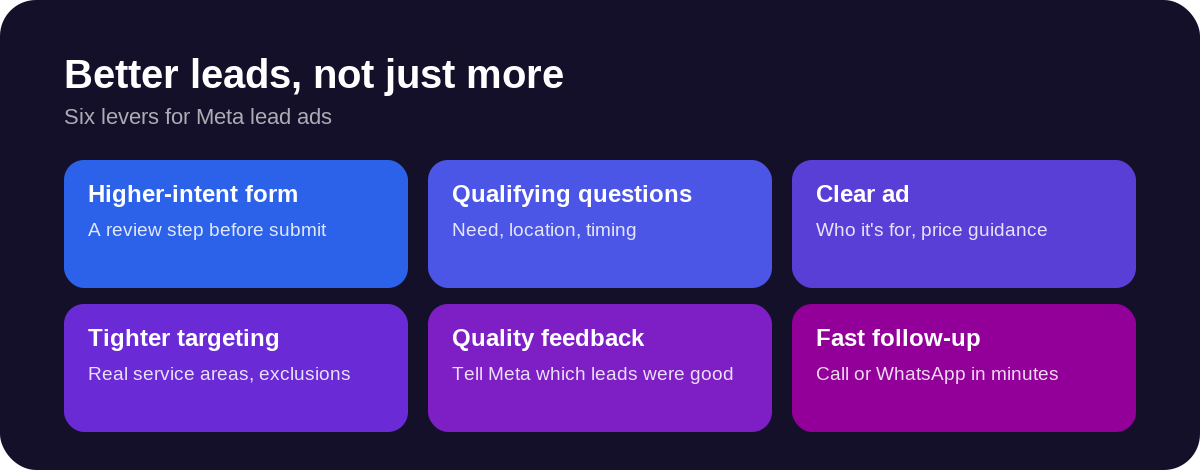
Six levers for better Meta leads
Why lead ads attract low-intent sign-ups
Instant forms pre-fill name, email and phone from the user's profile. Submitting takes two taps. That's great for volume and bad for intent: people tap out of curiosity, by accident, or to see a price, then forget.
1. Choose the higher-intent form type
When you create an instant form, Meta offers form types. The higher-intent type adds a review step so people confirm their details before submitting (guide by Jon Loomer). Expect fewer leads; that's the point.
2. Ask one to three qualifying questions
What do you need? (multiple choice of your services)
Where are you located? (if you serve specific areas)
When do you want to start?
Budget range (only if you can offer honest ranges)
Use multiple choice where possible; short answers are quicker for genuine buyers and filter out casual taps. Avoid long forms that kill completion.
3. Be clear in the ad itself
Ambiguity attracts the wrong people.
State who it's for: "For clinics in Mumbai", "For factories needing a new website"
Mention a starting price or range if you can
Say what happens next: "We'll call within working hours to understand your needs"
4. Tighten targeting and placements
Locations you actually serve, with "people living in" rather than broad interest where relevant
Exclude existing customers and past leads where possible
Review placements; some placements bring cheaper but weaker leads
Use lookalikes built from your best customers rather than all leads
5. Send quality signals back to Meta
Meta optimises for whatever you tell it is a conversion. If every form fill counts equally, it finds more form-fillers.
Mark leads in your CRM as qualified, contacted, won or junk
Connect your CRM or use Meta's conversion tools so Meta can optimise for qualified leads or sales rather than raw submissions
Remove obviously fake entries from your counts
6. Follow up within minutes
Call or WhatsApp immediately during working hours
Mention the ad and what they asked for, so they remember
Try at least three times across different times of day before marking a lead cold
Form or landing page?
Instant form
Landing page
Lead volume
Higher
Lower
Cost per lead
Usually lower
Usually higher
Lead intent
Mixed
Usually higher
Information you can show
Limited
Full: proof, process, prices
Best for
Simple offers, fast follow-up teams
Considered purchases, higher prices
Test both for your offer and compare cost per customer, not cost per lead.
Respect consent
Collect only what you need, explain how you'll contact people, and handle data in line with India's DPDP Act, 2023. Never buy or upload lists without consent.
The bottom line
Better Meta leads come from adding a little friction, asking the right questions, being clear in the ad, teaching Meta what a good lead looks like, and following up fast. You'll get fewer leads and more customers.
Instant forms pre-fill details, so it's easy to submit without much thought. Broad targeting, vague ads and slow follow-up make it worse. Adding friction, qualifying questions and faster calls usually helps.
What is a higher-intent form?
+
An instant form type that adds a review step before submission, so people confirm their details. It typically reduces volume but improves intent.
Should I use a lead form or a landing page?
+
Forms convert more because people stay in the app; landing pages usually bring fewer but better-informed leads. Test both for your offer.
How many questions should a lead form have?
+
Contact details plus one to three short qualifying questions, such as service needed, location or budget range. More than that and completion drops.
How fast should I contact a lead?
+
Within minutes if you can. People submit forms while scrolling and forget quickly; a quick call or WhatsApp message reaches far more of them.
Articles are written and reviewed by the Incinc Media team, the people who plan, design, build and market websites, apps and campaigns for businesses from our head office in Mumbai and our branch offices in Faridabad and Greater Noida. We write about the questions clients ask us every week.
Google catches people who are already searching. Meta reaches people before they search. Here's how to decide where your lead-generation budget should go first, and how to make either one work.
Likes don't pay bills. Here's how to set up your Instagram so the right people can enquire in one tap, the content that moves them, and how to tell which posts actually bring leads.
A 4x ROAS can still lose money. Here's how to calculate the numbers that matter, from cost per lead to real profit, with a worked example you can copy.
Read
Start a project
Telluswhat you'rebuilding.
Whether you need a digital product, a creative campaign or a complete digital transformation, let's build something meaningful together.