How Much Budget Do You Need for Google Ads in India? A Practical Way to Decide
There's no minimum spend on Google Ads, but there is a minimum that's useful. Here's how to work out a budget that buys enough data to learn from, and how Google actually spends it.
Google Ads has no fixed minimum spend: you set an average daily budget per campaign. Google can spend up to twice that on a busy day, but won't charge more than about 30.4 times the daily budget in a month. A useful budget is one that buys enough clicks to produce leads you can learn from: estimate clicks needed from your conversion rate, multiply by your expected cost per click, and plan for a few weeks of testing. GST at 18% applies on top.
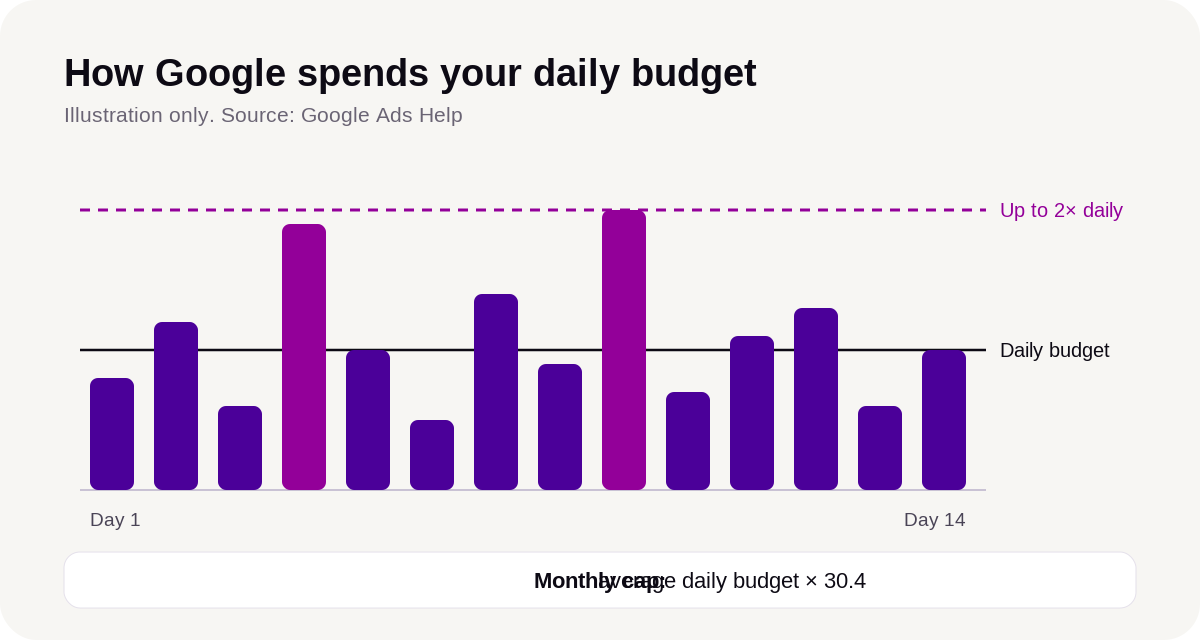
You set an average daily budget; Google may spend up to 2× on some days but caps the month at about 30.4× daily.
Start narrow: a few high-intent keywords in one location, then expand what works.
Track conversions before spending seriously, or you'll be guessing.
"How much should we spend on Google Ads?" is usually asked as if there's a standard answer. There isn't. The right budget depends on what a click costs in your market, how well your landing page converts and how many enquiries you need. The good news: you can work it out with simple maths before spending heavily.
How Google Ads budgets actually work
You set an average daily budget for each campaign. Two rules from Google Ads Help explain how it's spent:
Daily flexibility: on days with more search traffic, Google can spend up to twice your average daily budget (Google Ads Help).
Monthly limit: across a month, you won't be charged more than your average daily budget × 30.4, the average number of days in a month (Google Ads Help).
So a campaign set to ₹1,000 a day can spend up to ₹2,000 on a busy day, but no more than about ₹30,400 in the month. There's no fixed minimum spend for most campaigns; you choose the number.
Daily budget, daily flexibility and the monthly cap
Work out your budget from your goal
Use this simple model:
Leads you want per month, for example 40
Landing page conversion rate: the share of visitors who enquire. Use your own data if you have it; otherwise test, and assume conservatively until you do
Clicks needed = leads ÷ conversion rate
Cost per click (CPC): from Google's Keyword Planner estimates or a small test campaign
Monthly budget = clicks needed × CPC
Daily budget ≈ monthly budget ÷ 30.4
Step
Example (illustrative only)
Leads wanted per month
40
Landing page conversion rate
5%
Clicks needed
40 ÷ 0.05 = 800
Average CPC (from your own estimate)
₹40
Monthly media budget
800 × ₹40 = ₹32,000
Daily budget
₹32,000 ÷ 30.4 ≈ ₹1,050
Plus GST at 18%
Added to ad spend
These numbers are only an example to show the method. Your CPC and conversion rate will be different; find them with Keyword Planner and a test campaign.
Check it against the value of a customer
If one in five leads becomes a customer, 40 leads gives about 8 customers. Is the profit from 8 customers comfortably more than the ad spend plus management cost? If not, improve the offer, landing page or sales follow-up before increasing the budget.
What makes Google Ads expensive (or affordable)
Competition for your keywords. Legal, finance, education, real estate and B2B services are often costly; niche industrial terms can be cheaper.
Location. Targeting all of India costs more and wastes spend if you only serve Mumbai.
Keyword intent. "Website development company in Mumbai" signals buying intent; "what is a website" doesn't.
Ad and landing page quality. Relevant ads and useful landing pages improve performance and can reduce what you pay over time.
Match types and negatives. Broad targeting without negative keywords attracts irrelevant searches.
How to start without wasting money
Set up conversion tracking first: forms, calls and WhatsApp clicks. Without it, you can't tell what works.
Start narrow: a handful of high-intent keywords, your real service area, and a dedicated landing page.
Add negative keywords from day one (jobs, free, course, DIY, and anything unrelated to your offer).
Run for a few weeks before major changes, checking search terms weekly.
Scale what converts: increase budget on the keywords and ads that produce enquiries at an acceptable cost.
GST and billing in India
Google Ads spend attracts 18% GST. If you're billed by Google's Indian entity, GST appears on the invoice and GST-registered businesses can usually claim input tax credit. Billing setups vary, so confirm with your chartered accountant (explainer). Budget for GST on top of your planned ad spend.
Common budget mistakes
Too small to learn. A budget that buys only a handful of clicks a week can't tell you anything.
Too broad too soon. Targeting every related keyword across India spreads the budget thin.
Sending ads to the homepage. A focused landing page usually converts far better.
Judging after three days. Campaigns need time and data.
Ignoring the search terms report. It shows what people actually typed; prune irrelevant ones weekly.
How much should you spend on management?
Management fees are separate from ad spend. They cover strategy, setup, ad copy, landing page advice, optimisation and reporting. Our digital marketing cost guide explains how fees are structured, and our Google Ads vs Meta Ads guide helps decide whether Google is the right starting channel.
The bottom line
The right Google Ads budget comes from your own numbers: leads needed, conversion rate and cost per click, plus GST. Start narrow with tracking in place, give the campaign time to learn, and scale what produces enquiries at a cost your business can sustain. Weighing ads against organic search? See SEO vs Google Ads.
If you'd like help estimating costs for your keywords and running a focused test, our performance marketing team can set it up properly from day one.
Frequently asked questions
What is the minimum budget for Google Ads in India?
+
Google Ads doesn't set a fixed minimum spend for most campaigns. The practical minimum is the budget that buys enough clicks each month to generate leads and data you can act on, which depends on your keywords' cost per click.
Can Google spend more than my daily budget?
+
Yes. On days with more traffic, Google can spend up to twice your average daily budget. Across the month, you won't be charged more than your average daily budget multiplied by 30.4 (the average days in a month).
Is GST charged on Google Ads in India?
+
Yes, 18% GST applies. If you're billed by Google's Indian entity it's added to the invoice, and GST-registered businesses can usually claim input tax credit. Confirm your billing setup with your accountant.
How long should I test before judging Google Ads?
+
Give a new campaign a few weeks and enough clicks to collect meaningful data, especially if you use automated bidding, which needs conversions to learn. Avoid making big changes every few days.
Should I use automated bidding from day one?
+
Automated strategies like Maximise Conversions work best once conversion tracking is set up correctly and the campaign has some conversion history. Many advertisers start with clicks or manual control in a small, focused campaign, then switch once data builds.
Articles are written and reviewed by the Incinc Media team, the people who plan, design, build and market websites, apps and campaigns for businesses from our head office in Mumbai and our branch offices in Faridabad and Greater Noida. We write about the questions clients ask us every week.
A 4x ROAS can still lose money. Here's how to calculate the numbers that matter, from cost per lead to real profit, with a worked example you can copy.
When Google Ads don't bring leads, the problem is rarely 'Google Ads doesn't work for us'. It's usually tracking, search terms, the landing page or follow-up. Here's how to find which.
Google Ads switches on in days and stops when you stop paying. SEO takes months and keeps working. Most growing businesses need a plan for both, in the right order.
Read
Start a project
Telluswhat you'rebuilding.
Whether you need a digital product, a creative campaign or a complete digital transformation, let's build something meaningful together.