How to Build a Digital Marketing Strategy from Scratch (A One-Page Plan)
Most businesses don't need a 40-page strategy deck. They need clear answers to seven questions, written on one page, and the discipline to review it every month.
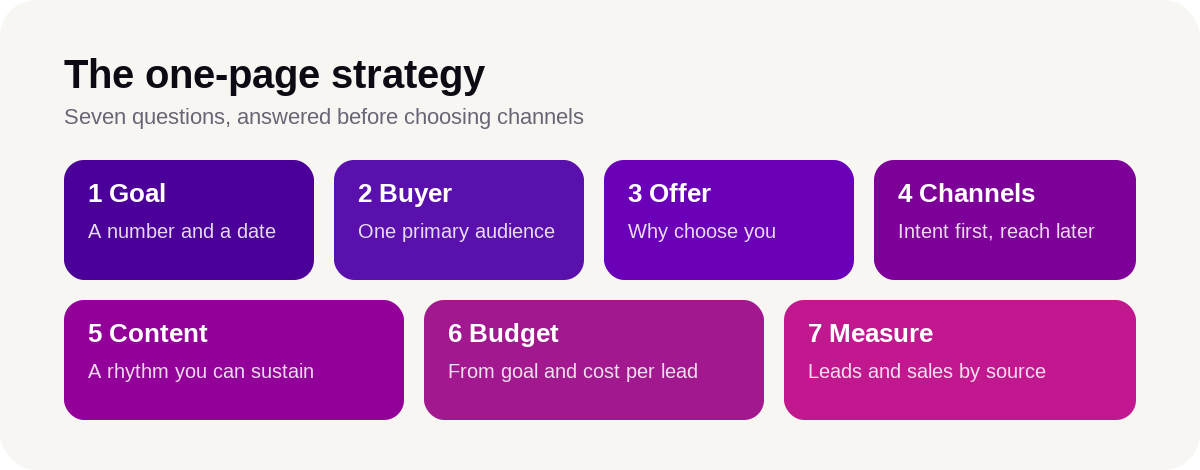
A digital marketing strategy answers seven questions: what you want to achieve and by when, who you're selling to, what makes your offer worth choosing, where those buyers spend time online, what content and campaigns you'll run there, how much you'll spend and where, and how you'll measure results. Start with the channels closest to buying intent (Google Business Profile, search, your website), add reach channels later, and review the one-page plan monthly using enquiries and sales by source.
Start from a measurable business goal, not from channels.
Define one primary buyer and the problem you solve for them.
Fix your website and Google presence before spending on reach.
Review monthly using leads and sales by source, then shift budget to what works.
Many businesses start digital marketing from the wrong end: "We should be on Instagram", "Let's try Google Ads", "Our competitor has a blog". Channels come last. A strategy starts with what the business needs, and the channels follow.
Here's a seven-question framework that fits on one page.
Seven questions, one page
1. What do you want, by when?
Turn "more business" into a number and a date:
"40 qualified enquiries a month by March"
"₹10 lakh in online sales this quarter"
"Fill the new clinic's appointment book within 90 days"
Then work backwards: if 1 in 5 enquiries becomes a customer, 40 enquiries means about 8 customers.
2. Who exactly are you selling to?
Pick one primary buyer and describe them:
Who they are (business owner, HR head, parent, homeowner)
Where they are (city, area, country)
The problem they want solved, in their words
What makes them hesitate (price, trust, time)
3. Why should they choose you?
Write one sentence that answers: "Why you, not the alternative?" Specific beats generic: "Industrial websites built and launched in six weeks, with product catalogues your team can update" beats "quality and innovation".
4. Where will you reach them?
Start close to buying intent, then widen:
Stage
Channels
Why
Already searching
Google Business Profile, SEO, Google Ads
They're looking for what you sell right now
Comparing
Website, reviews, case studies, comparison content
Where decisions are made
Not yet looking
Instagram, Meta ads, LinkedIn, YouTube
Builds demand and familiarity
Past customers
WhatsApp, email
Repeat business and referrals
Most small businesses should get the first two rows working before spending heavily on the third. See SEO vs Google Ads for search.
5. What will you publish and run?
For each chosen channel, decide a sustainable rhythm:
Website: service pages that answer buyer questions; one helpful article a week or fortnight
Google Business Profile: weekly post, photos, review replies (Help Centre)
Month 1: fix website conversion, Google Business Profile and tracking
Month 2: launch search (SEO basics plus a focused ads test)
Month 3: add one reach channel; review cost per lead by source
Every month: move budget towards what brings customers
The bottom line
A good digital marketing strategy is short: a clear goal, one buyer, a reason to choose you, channels in the right order, a sustainable content rhythm, a budget and a monthly review. Write it on one page and keep it alive.
A plan for how you'll use online channels to reach your goals: who you target, what you offer, which channels you use, what you spend, and how you measure success.
Which channels should a small business start with?
+
Usually Google Business Profile, a website that converts, and search (SEO and Google Ads), because they reach people already looking. Add social media and Meta ads to build demand once the basics work.
How much should I spend on digital marketing?
+
There's no universal figure. Work back from your goal: the customers you need, your conversion rate and your cost per lead. Start with a test budget, measure, then scale what works.
How often should the strategy change?
+
Review results monthly and adjust tactics and budget. Revisit the overall strategy every quarter or when your business, offer or market changes.
Do I need an agency to make a strategy?
+
Not necessarily. This one-page plan works on your own. An agency helps when you need specialist execution, or an outside view of what isn't working.
Articles are written and reviewed by the Incinc Media team, the people who plan, design, build and market websites, apps and campaigns for businesses from our head office in Mumbai and our branch offices in Faridabad and Greater Noida. We write about the questions clients ask us every week.
Most confusion about marketing budgets comes from mixing two different costs: what you pay the agency and what you pay Google or Meta. Here's how pricing really works and how to plan a budget that can produce results.
More traffic isn't the goal. More genuine enquiries are. Here's a step-by-step plan that works for service businesses, manufacturers and local brands in India.
A 4x ROAS can still lose money. Here's how to calculate the numbers that matter, from cost per lead to real profit, with a worked example you can copy.
Read
Start a project
Telluswhat you'rebuilding.
Whether you need a digital product, a creative campaign or a complete digital transformation, let's build something meaningful together.