How Much Does Digital Marketing Cost in India? Fees, Ad Spend and What You Get
Most confusion about marketing budgets comes from mixing two different costs: what you pay the agency and what you pay Google or Meta. Here's how pricing really works and how to plan a budget that can produce results.
Digital marketing cost in India has two parts: the agency or team fee for strategy, content, management and reporting, and the media (ad) spend paid directly to platforms like Google and Meta. Fees depend on the channels, content volume, shoot days and reporting depth; ad spend depends on your market's costs and how many leads you need. GST at 18% applies to agency invoices and to ad spend, and how it's charged on ad spend depends on which entity bills you.
Always separate the management fee from ad spend when comparing proposals.
Content production (shoots, reels, design) is often the biggest driver of social media fees.
SEO is a monthly investment in fixes and content whose results build over months.
Set budgets backwards from the number of enquiries you need and your sales conversion rate.
Ask agencies for digital marketing prices and the numbers can look impossible to compare. One proposal includes ad spend, another doesn't; one includes three shoot days a month, another uses stock images; one reports on leads and sales, another on likes.
This guide explains how digital marketing is priced in India, what each service usually includes, and how to set a budget that can realistically produce enquiries.
The two costs: fees and media
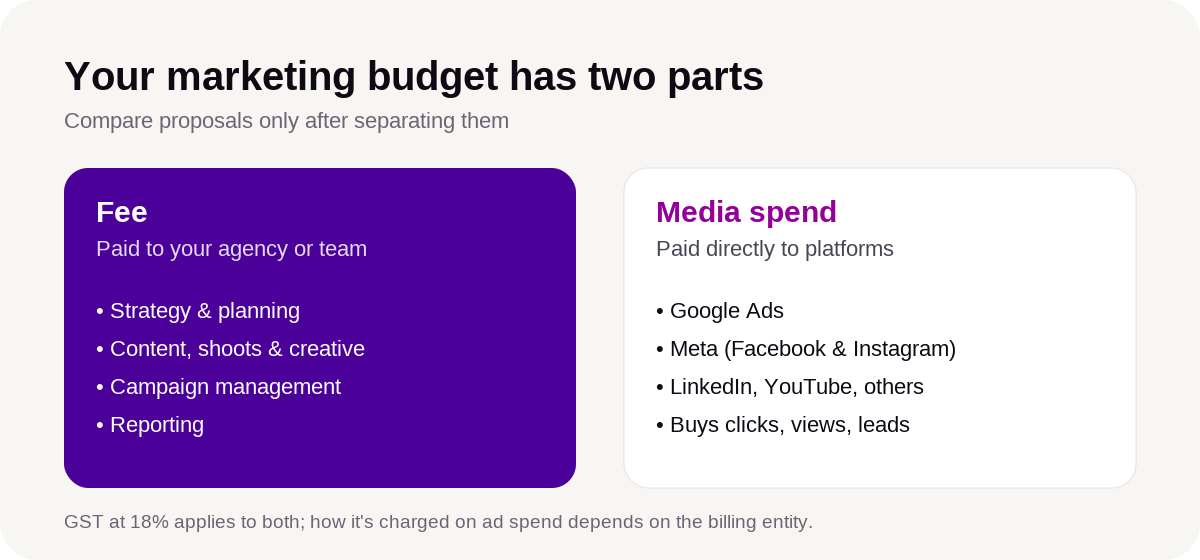
Every digital marketing budget has two parts. Keeping them separate makes proposals comparable.
Management and content fee
Media (ad) spend
Paid to
The agency, freelancer or your in-house team
Google, Meta, LinkedIn and other platforms
Covers
Strategy, creative, content, campaign setup and optimisation, reporting
The clicks, impressions, views and leads you buy
Scales with
Channels, content volume, complexity
How many people you want to reach and your market's costs
GST
18% on agency invoices
18%, charged on the invoice or under reverse charge depending on the billing entity
Some agencies charge a percentage of ad spend instead of a fixed fee. Either model can be fair; just make sure you know which one you're comparing.
Fees and media: two separate budgets
What drives the fee for each service
Social media management
The biggest cost driver is content production:
Number of platforms (Instagram, Facebook, LinkedIn, YouTube)
Posts, carousels and stories per month
Reels and video: scripting, shooting and editing take far longer than static posts
Shoot days, locations, models or creators
Community management: replying to comments and messages, and how fast
Reporting depth
A plan with original reels shot every month costs more than one built on templated graphics, and usually performs very differently. Our social media management page explains what we include.
SEO
SEO fees depend on the size and condition of your website, how competitive your market is, and how much content needs creating. A typical monthly plan covers:
Technical fixes and monitoring
On-page improvements to key pages
New content (guides, service and location pages)
Local SEO and Google Business Profile management
Link-earning activity and reporting
SEO is an investment whose returns build over months. Be wary of very cheap packages that promise rankings; Google itself warns against guarantees. See our SEO vs AEO vs GEO guide for how search is changing.
Paid ads management (Google and Meta)
The fee covers campaign strategy, setup, creatives, landing page advice, ongoing optimisation and reporting. It depends on:
Blog articles, landing pages, brochures, product photography, brand films and design are often priced per deliverable or bundled into retainers.
GST on digital marketing
Agency fees: digital marketing services attract 18% GST in India (reference). Check whether quotes are "plus GST".
Ad spend: 18% GST also applies. If you're billed by the platform's Indian entity, it appears on the invoice and registered businesses can usually claim input tax credit. If you're billed by an overseas entity, a GST-registered advertiser may need to pay it under reverse charge (explainer).
Tax treatment depends on your registration and billing setup, so confirm with your chartered accountant.
How to set a realistic budget
Work backwards from what the business needs:
Target: how many new customers do you want per month?
Conversion rate: from your own history, what share of enquiries become customers?
Cost per enquiry: from a test campaign or past data in your market
Media budget = enquiries needed × cost per enquiry
Add fees for management, content and creative
For example, if you want 10 new clients a month and one in five enquiries usually converts, you need about 50 enquiries. Multiply by the cost per enquiry you see in your market to get a media budget. Then check that the value of 10 clients comfortably covers media plus fees. If it doesn't, the issue is the offer, pricing or conversion process, not the marketing budget.
What a good proposal includes
Goals and how they'll be measured (enquiries, cost per enquiry, sales where trackable)
Channels and why they were chosen
Monthly deliverables, with quantities
Who works on your account
What's included in the fee and what's billed separately (ad spend, shoots, travel, tools)
Reporting frequency and format
Contract length and notice period
Ownership of ad accounts, pages, creatives and data (they should be yours)
Common budgeting mistakes
Spreading a small budget across every channel. Start with one or two and do them well.
Paying for content but not distribution. Great posts with no ad budget may reach very few people.
Judging on likes and followers. Track enquiries and sales.
No conversion tracking. Without it, you can't tell which spend works.
Switching agencies or channels every month. Most channels need time to learn and compound.
The bottom line
Digital marketing cost in India is the sum of what you pay your team or agency and what you pay the platforms. Separate the two, compare deliverables rather than headline fees, and build the budget backwards from the enquiries you need.
What is a good digital marketing budget for a small business?
+
Work backwards from goals: how many enquiries or sales you need, your conversion rate and the cost per lead in your market. That gives a realistic ad budget. Add the management and content cost on top. Start focused on one or two channels rather than spreading thin.
Is ad spend included in agency fees?
+
Usually not. Most agencies charge a management fee, and ad spend is paid directly to Google or Meta from your account. Some charge a percentage of ad spend instead of, or in addition to, a fixed fee. Make sure every proposal states this clearly.
Is GST charged on Google and Meta ads in India?
+
Yes, 18% GST applies. If you're billed by the platform's Indian entity, GST appears on the invoice and GST-registered businesses can usually claim input tax credit. If you're billed by an overseas entity, a GST-registered advertiser may have to pay it under reverse charge. Check with your accountant.
Why do some agencies charge much less than others?
+
Lower fees often mean fewer deliverables (fewer posts, no original shoots, templated creatives), less senior people, less strategy and lighter reporting. Compare the deliverables and the team, not just the monthly figure.
How long before digital marketing shows results?
+
Paid ads can produce enquiries within days once tracking and landing pages are right. SEO and organic social media build over months. A sensible plan uses ads for near-term leads while organic channels grow.
Articles are written and reviewed by the Incinc Media team, the people who plan, design, build and market websites, apps and campaigns for businesses from our head office in Mumbai and our branch offices in Faridabad and Greater Noida. We write about the questions clients ask us every week.
Tell us your goals and current spend. We'll recommend the channels to start with, split the budget between fees and media, and explain what results to expect and when.
Most businesses don't need a 40-page strategy deck. They need clear answers to seven questions, written on one page, and the discipline to review it every month.
One agency quotes a small monthly fee, another quotes several times more, and both say 'social media management'. The difference is in what's actually included. Here's how to read a quote.
Google catches people who are already searching. Meta reaches people before they search. Here's how to decide where your lead-generation budget should go first, and how to make either one work.
Read
Start a project
Telluswhat you'rebuilding.
Whether you need a digital product, a creative campaign or a complete digital transformation, let's build something meaningful together.