Why Digital Marketing Campaigns Fail (and How to Fix Yours)
When a campaign doesn't work, the platform usually gets the blame. More often the cause is upstream: an unclear goal, missing tracking, a weak offer, the wrong page or leads left waiting.
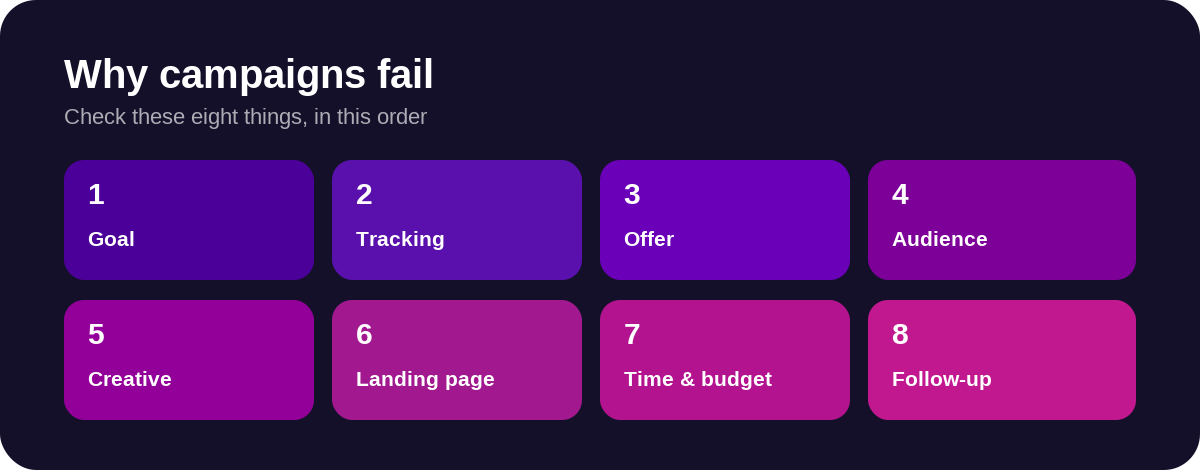
Digital marketing campaigns usually fail for reasons that have little to do with the platform: no clear, measurable goal; tracking that doesn't record enquiries or sales; an offer that isn't compelling; targeting that's too broad or too narrow; creative that doesn't stop the scroll; a landing page that doesn't match the ad; too little time or budget to learn; and slow follow-up on leads. Diagnose in that order, fix one thing at a time, and judge success by cost per customer.
Set one measurable goal per campaign before choosing channels or creative.
Check tracking first: without it, platforms optimise blind and you can't judge results.
A strong offer and a matching landing page fix more campaigns than new targeting.
Fast follow-up turns paid-for leads into customers.
"We tried digital marketing and it didn't work" usually means a campaign ran for a few weeks, money was spent, and enquiries didn't come. It's tempting to blame Instagram, Google or the agency. In most campaigns we review, the cause is something more basic, and fixable.
Here are the eight most common reasons campaigns fail, in the order we check them.
Eight checks, in order
1. No clear, measurable goal
"Increase brand awareness" or "get more sales" can't be managed. A campaign needs one goal with a number and a date: "60 enquiries for the new course by 31 January".
Fix: write the goal, the conversion that counts (form, call, WhatsApp, purchase) and the target cost per lead before anything else. Our one-page strategy helps.
2. Tracking that doesn't track
If enquiries and sales aren't recorded as conversions, platforms optimise for clicks or cheap form fills, and you can't tell what's working. Google's guidance on what to track for your goals is a good starting point.
Fix: track forms, calls, WhatsApp clicks and purchases, test them yourself, and record lead sources in a sheet or CRM.
3. A weak or unclear offer
People respond to offers, not to the fact that you're advertising. "We make websites" is not an offer. "A fast, mobile-first website for your clinic, live in 4 weeks, fixed price" is.
Fix: make it specific: who it's for, what they get, why now, and what happens next.
4. The wrong audience
Too broad, and you pay for curious scrollers. Too narrow, and the platform can't find enough people. Searches that don't match your service waste money on Google.
Fix: target where buyers are (locations you serve, relevant intent), exclude what doesn't fit, and review search terms and placements regularly.
5. Creative that doesn't stop the scroll
On social media, the first seconds decide everything. Generic stock images and long text lose people instantly.
Sending ads to your home page, or to a page that says something different from the ad, is one of the most common leaks.
Fix: one focused page per offer, with the same promise as the ad, proof and one clear action. See the anatomy of a landing page.
7. Not enough time or budget to learn
Ad platforms need data to optimise. A tiny budget spread across many ads, or a campaign stopped after a few days, rarely shows what could work.
Fix: concentrate budget on fewer ads and audiences, give it a few weeks, and change one major thing at a time.
8. Slow follow-up
A campaign can produce good leads that go cold because nobody called for two days.
Fix: reply within minutes during working hours, use WhatsApp, and track which leads became customers.
A quick campaign health check
Check
Ask
Goal
Is there one number and date?
Tracking
Do test enquiries show up as conversions?
Offer
Would you respond to it?
Audience
Are search terms or audiences relevant?
Creative
Does it say something specific in the first seconds?
Page
Does it match the ad, with one clear action?
Time and budget
Has it had enough of both to learn?
Follow-up
How fast are leads contacted?
The bottom line
Most campaigns fail before the first ad runs: a vague goal, broken tracking, a weak offer or the wrong page. Fix those, give the campaign time and budget to learn, follow up fast, and judge it by cost per customer. See how to calculate advertising ROI.
How long should I run a campaign before judging it?
+
Long enough to collect meaningful data, usually a few weeks, but check tracking and obvious problems like wrong searches or a broken form in the first few days.
Is it the agency or the strategy?
+
Often neither alone. Check the basics together: goal, tracking, offer, page and follow-up. A good agency will walk through these with you openly.
Should I change many things at once to fix a campaign?
+
No. Change one major thing at a time, such as the offer or landing page, so you know what made the difference.
Why do I get clicks but no enquiries?
+
Usually a mismatch between the ad and the page, a weak or unclear offer, a slow or confusing page, or targeting that brings curious people rather than buyers.
What's the right metric to judge success?
+
Cost per customer or return on ad spend, using real sales data. Clicks, likes and even leads are only steps along the way.
Articles are written and reviewed by the Incinc Media team, the people who plan, design, build and market websites, apps and campaigns for businesses from our head office in Mumbai and our branch offices in Faridabad and Greater Noida. We write about the questions clients ask us every week.
Share what you're running and the results so far. We'll walk through goal, tracking, offer, page and follow-up, and tell you honestly what to fix first.
Most businesses don't need a 40-page strategy deck. They need clear answers to seven questions, written on one page, and the discipline to review it every month.
When Google Ads don't bring leads, the problem is rarely 'Google Ads doesn't work for us'. It's usually tracking, search terms, the landing page or follow-up. Here's how to find which.
A 4x ROAS can still lose money. Here's how to calculate the numbers that matter, from cost per lead to real profit, with a worked example you can copy.
Read
Start a project
Telluswhat you'rebuilding.
Whether you need a digital product, a creative campaign or a complete digital transformation, let's build something meaningful together.