How to Digitally Transform a Traditional Business: A Step-by-Step Plan
Digital transformation doesn't mean replacing everything at once. For a shop, factory, distributor or practice, it's a sequence of small, sensible upgrades. Here's the order that works.
To digitally transform a traditional business, start with the problems that cost you most, then upgrade in stages: get found online (website and Google Business Profile), capture and answer enquiries in one place, digitise billing, payments and stock, move customer records into a CRM, add online selling where it fits (your own store, marketplaces or ONDC), and finally use the data to decide. Keep staff involved, protect customer data, and measure each step before the next.
Start from your biggest bottleneck, not from a technology wish list.
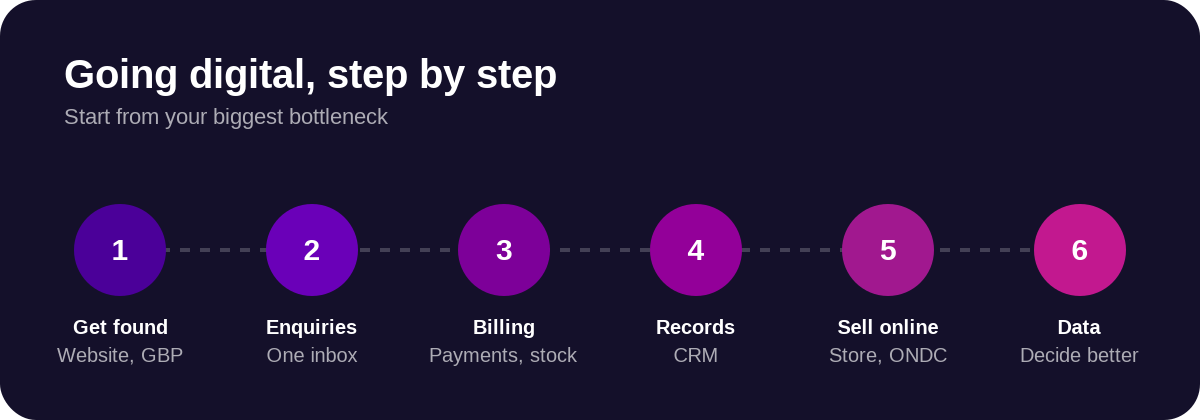
Go step by step: presence, enquiries, billing, records, selling, data.
Train and involve staff; adoption matters more than the software.
Collect only the customer data you need, and keep it secure.
Many successful businesses in India still run on phone calls, paper registers and a trusted accountant. That has worked for years. But customers now search online before they call, compare on their phones and expect quick replies on WhatsApp. Digital transformation is how a traditional business keeps up, without throwing away what already works.
It doesn't mean buying expensive software or changing everything at once. It's a sequence of practical upgrades, each solving a real problem.
Six stages, one at a time
Before you start: find the bottleneck
Ask where the business loses the most time or money today:
Customers can't find you, or find a competitor first?
Enquiries get missed or answered late?
Billing, payments or stock are tracked on paper and often wrong?
Customer history lives in one person's head?
Start with the stage that fixes your biggest problem. The order below suits most businesses.
Move invoices, payments and inventory into accounting or billing software. Accept UPI and online payments, and reconcile automatically. GST e-invoicing is mandatory above a turnover threshold, reduced to ₹5 crore; check the current rule with your accountant.
Stage 4: Move customer records into a CRM
A CRM keeps every customer's history, follow-ups and orders in one place that the whole team can see. Start simple; our guide on choosing a CRM covers what to look for.
Stage 5: Sell online where it fits
Depending on your products, options include your own online store, marketplaces, and ONDC, a Government of India initiative that builds an open network for digital commerce, which sellers join through seller-side apps. Many businesses use more than one. If you haven't yet, Udyam registration is free and online, and is needed for many MSME schemes.
Stage 6: Use your data to decide
Once sales, enquiries and stock are digital, you can see what's selling, which channels bring customers and where time is wasted. A simple weekly dashboard is enough to start. Then automate the repetitive work.
Make it stick: people and data
Involve your team early. Show how the new tool saves them effort. Train in short sessions and keep a simple guide.
Run old and new in parallel briefly, then switch fully. Two systems for months creates confusion.
Protect customer data. Collect only what you need, control who can access it and use strong passwords. India's data protection framework makes this a legal responsibility too.
Measure each stage before starting the next: faster replies, fewer billing errors, more enquiries.
A realistic roadmap
Timeline
Focus
Month 1
Website, Google Business Profile, WhatsApp Business
Months 2 to 3
Digital billing, payments and stock
Months 3 to 4
CRM and follow-up process
Months 4 to 6
Online selling and simple automation
Ongoing
Weekly data review and improvements
The bottom line
Digital transformation for a traditional business is a series of sensible steps: get found, answer faster, run billing and records digitally, sell online where it fits and use the data. Start with your biggest bottleneck, bring your team along and measure as you go.
Our technology team builds websites, online stores, custom tools and integrations for businesses making this shift. If off-the-shelf tools don't fit your process, read when to build custom software.
Frequently asked questions
Is digital transformation only for big companies?
+
No. For a small business it means using simple digital tools to get found, serve customers faster and run operations with less paperwork. Many of the tools are free or low cost.
Where should a traditional business start?
+
With a website and a complete Google Business Profile so customers can find you, and a single place to capture and answer enquiries. These usually show results fastest.
Do I need to register as an MSME?
+
It isn't required to go digital, but Udyam registration is free and online, and it's needed for many MSME schemes and benefits. Check eligibility on the official Udyam portal.
What is ONDC and should I join?
+
ONDC is a Government of India initiative that creates an open network for digital commerce. Sellers join through seller-side apps. It can be worth exploring alongside your own website and marketplaces, depending on your products.
How long does it take?
+
The first steps, like a website, Google Business Profile and digital billing, can be done in weeks. A full transformation is gradual, typically over months, one process at a time.
Articles are written and reviewed by the Incinc Media team, the people who plan, design, build and market websites, apps and campaigns for businesses from our head office in Mumbai and our branch offices in Faridabad and Greater Noida. We write about the questions clients ask us every week.
Most owners lose hours every day to copy-paste work: retyping enquiries, chasing payments, sending the same replies. Here's what to automate first, with tools you can start using this week.
If your leads live in WhatsApp chats, notebooks and three different Excel files, you're losing customers you never knew you had. Here's how to choose a CRM that your team will actually use.
Your Instagram can grow fast, but you don't own it, Google rarely shows it for buying searches, and it can't answer every question a customer has. A website does those jobs.
Read
Start a project
Telluswhat you'rebuilding.
Whether you need a digital product, a creative campaign or a complete digital transformation, let's build something meaningful together.