Google Ads vs Meta Ads: Which Is Better for Lead Generation in India?
Google catches people who are already searching. Meta reaches people before they search. Here's how to decide where your lead-generation budget should go first, and how to make either one work.
Google Ads is usually better when people already search for your service (for example, 'CA firm near me' or 'industrial sifter manufacturer'), because you reach them at the moment of intent. Meta Ads (Facebook and Instagram) is usually better for creating demand, visual products, local offers and reaching audiences who don't yet search. Many businesses do best starting with search for high-intent leads, then adding Meta for reach and retargeting, with proper conversion tracking on both.
Google Ads = demand capture (people searching). Meta Ads = demand creation (people scrolling).
Neither platform has a fixed minimum spend for most campaigns; you set your own budget.
Lead quality depends on targeting, the offer, the form and how fast you follow up, not just the platform.
Track real enquiries and sales on both platforms before judging which works better.
"Should we run Google Ads or Facebook ads?" is one of the most common questions we hear from business owners in Mumbai. The honest answer is: it depends on whether your customers are already looking for you. Google and Meta reach people at very different moments, and a campaign built for one usually fails on the other.
The core difference: intent vs attention
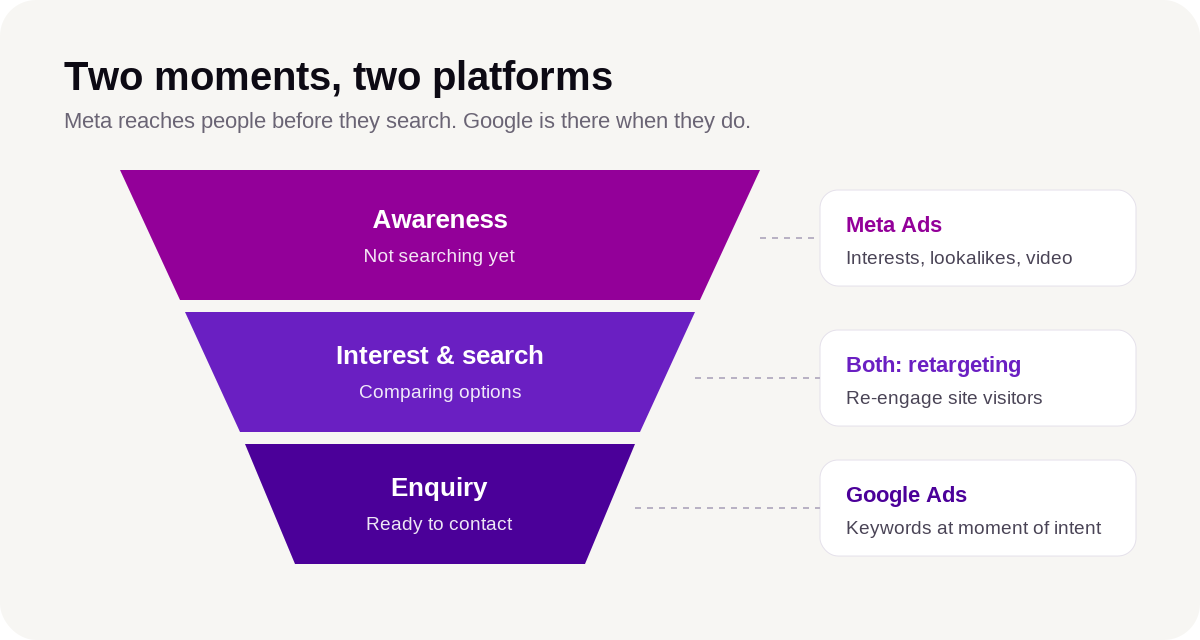
Google Ads shows your ad when someone searches for something specific: "website development company in Mumbai", "pharma machine manufacturer", "dentist near Ghatkopar". You're reaching existing demand, at the moment of intent.
Meta Ads (Facebook and Instagram) shows your ad to people based on who they are, what they're interested in and how they behave, while they're scrolling. You're creating demand: getting your offer in front of people who match your customer profile but aren't searching right now.
Meta creates demand; Google captures it
Side-by-side comparison
Google Ads
Meta Ads (Facebook & Instagram)
How you target
Keywords people search, plus location, device and audience signals
Building awareness, visual products, offers, retargeting
Lead form options
Website landing pages, call ads, lead form assets
Instant forms inside Facebook/Instagram, website, WhatsApp, Messenger
Creative needs
Strong ad copy and landing page; images for some formats
Scroll-stopping images and short videos are essential
Typical lead quality
Higher intent, often higher cost
Higher volume, needs qualification
Works well for
Services people search for, B2B, urgent needs, local services
Consumer brands, real estate, education, events, restaurants, launches
When Google Ads is the better starting point
Start with Google if most of these are true:
People already search for your service or product by name
The need is urgent or specific (repairs, medical, legal, industrial equipment)
You sell B2B, where buyers research before they enquire
You serve a defined area and want calls from nearby customers
Your offer is hard to explain in a scroll-stopping visual
For a manufacturer of specialised machinery, for example, the number of people searching may be small, but almost every one of them is a potential buyer. Search ads let you be there when they look.
When Meta Ads is the better starting point
Start with Meta if most of these are true:
People don't yet search for what you offer, or the category is new
Your product is visual: food, fashion, interiors, beauty, property, events
You have a strong offer (a launch, a site visit, a trial class)
Your audience can be described by age, location, interests or life events
You want to build a brand audience you can retarget later
How this plays out by industry
These are typical starting points we'd consider, not rules. Your own tracking should decide.
Business type
Usual starting point
Why
B2B manufacturer or industrial supplier
Google Search
Buyers search for specific products and specifications
Clinic, dentist or diagnostic centre
Google Search, then Meta for awareness
Urgent, local, high-intent searches
Real estate project
Meta, with Google for project-name searches
Visual, audience-based targeting; buyers also search project names
Restaurant or café
Meta (Instagram)
Visual, local, impulse-driven
Coaching or education
Both
Parents and students search, and also respond to social proof
D2C consumer brand
Meta, then Google Shopping and Search
Demand creation first, then capturing brand and product searches
Professional services (CA, legal, consulting)
Google Search
People search when they have a specific need
Budgets: what you actually need
Neither platform imposes a fixed minimum spend for most campaigns; you set your own budget. Google's own guide to Google Ads costs explains that there's no fixed price tag and you control your daily or campaign budget. Note that Google may spend up to twice your average daily budget on some days to catch more traffic, while keeping monthly spend within your limit, as explained in Google Ads Help under average daily budgets.
The practical question is: will your budget buy enough clicks or leads to learn from? Work backwards:
Estimate how many leads you need per month.
Estimate the share of leads that become customers (from your own sales history).
Estimate cost per click or cost per lead for your market, from a small test campaign or keyword planner estimates.
Budget enough for at least a few weeks of learning before judging results.
A budget that's too thin spread across both platforms is the most common reason "ads didn't work".
Lead quality: the part most businesses miss
Platforms optimise for what you tell them to. If you tell Meta to find "leads", it will find people who fill forms, not necessarily people who buy. To improve quality on either platform:
Qualify in the form. Ask one or two questions that matter: budget range, city, timeline, business type. Meta's lead ads support custom questions and conditional logic.
Use landing pages that match the ad. One page, one offer, one clear action. See our landing page anatomy guide.
Follow up fast. A lead who hears back within minutes, while they're still thinking about your offer, is usually far easier to convert than one called the next day.
Feed results back. Mark which leads became customers and use conversion tracking so the platforms learn from real sales, not just form fills.
Tracking: decide on facts, not feelings
Before comparing platforms, make sure you can see:
Form submissions, calls and WhatsApp clicks as conversions
Which campaign, ad and keyword produced each lead
Which leads turned into customers, and their value
Without this, the platform with the cheapest-looking leads usually wins the argument, even if it produces the fewest customers. Our guide on what to measure in marketing covers a simple setup.
A practical plan for most Indian SMEs
Fix the basics: a fast landing page, conversion tracking, and a process for answering leads quickly.
Start where intent is: if people search for your service, begin with a focused Google Search campaign on your most specific keywords.
Add Meta for reach: build awareness among your ideal customers and retarget website visitors who didn't enquire.
Review every week, decide every month: compare cost per qualified lead and cost per customer, then move budget to what works.
Common mistakes
Broad keywords on Google. "Website" or "marketing" attract the wrong searches. Be specific, and add negative keywords.
Boosting posts instead of running campaigns on Meta. Boosts are convenient but offer fewer objectives and less control.
Sending ads to the homepage. Use a focused landing page.
Changing everything too quickly. Give campaigns time to learn before major changes.
Ignoring creative. On Meta especially, the image or video is the targeting: it decides who stops scrolling.
The bottom line
Google Ads captures demand that already exists; Meta Ads creates demand and builds familiarity. The best choice is the one that matches how your customers buy, and the best results usually come from using both deliberately, with tracking that shows real enquiries.
Meta often shows a lower cost per click or per lead, but those leads may be less ready to buy. Google clicks can cost more because the person is actively searching. Judge platforms on cost per qualified lead or sale, not cost per click.
What is the minimum budget for Google Ads in India?
+
Google Ads doesn't set a fixed minimum spend for most campaigns; you choose a daily or total budget. In practice, your budget needs to cover enough clicks at your market's cost per click to produce meaningful data. Note that Google may spend up to twice your average daily budget on some days while staying within your monthly limit.
Are Meta lead form leads good quality?
+
Instant forms make submitting very easy, which increases volume but can reduce intent. You can improve quality with a 'higher intent' form type, qualifying questions and fast follow-up by phone or WhatsApp.
Should a small business run both Google and Meta ads?
+
If budget is limited, start with the platform that matches how your customers find you, prove it works with proper tracking, then add the second. Running both thinly often means neither gets enough budget to learn.
How long before ads generate leads?
+
Campaigns can produce enquiries within days of launch if tracking, targeting and landing pages are right. Expect a learning period of a few weeks before performance stabilises and you can optimise confidently.
Articles are written and reviewed by the Incinc Media team, the people who plan, design, build and market websites, apps and campaigns for businesses from our head office in Mumbai and our branch offices in Faridabad and Greater Noida. We write about the questions clients ask us every week.
We'll review your offer, budget and tracking and recommend where to start, then build and manage campaigns with landing pages and creatives produced in-house.
Meta lead ads can fill a sheet with names that never pick up the phone. The fix is a mix of form settings, honest qualifying questions, clearer ads and fast follow-up.
More traffic isn't the goal. More genuine enquiries are. Here's a step-by-step plan that works for service businesses, manufacturers and local brands in India.
A 4x ROAS can still lose money. Here's how to calculate the numbers that matter, from cost per lead to real profit, with a worked example you can copy.
Read
Start a project
Telluswhat you'rebuilding.
Whether you need a digital product, a creative campaign or a complete digital transformation, let's build something meaningful together.