How to Redesign a Website Without Losing SEO: A Step-by-Step Checklist
A redesign can lift enquiries or wipe out years of rankings. The difference is usually a few hours of planning: mapping old URLs, redirecting properly, keeping what ranks and checking everything after launch.
To redesign a website without losing SEO, record your current rankings and traffic, list every URL, keep URLs that work, map every changed URL to its closest new page with permanent server-side 301 or 308 redirects, keep the content and titles that rank, carry over structured data and internal links, remove any noindex or robots.txt blocks before launch, submit the new sitemap and watch Search Console closely. Google recommends keeping redirects for at least a year. Some fluctuation after a large move is normal.
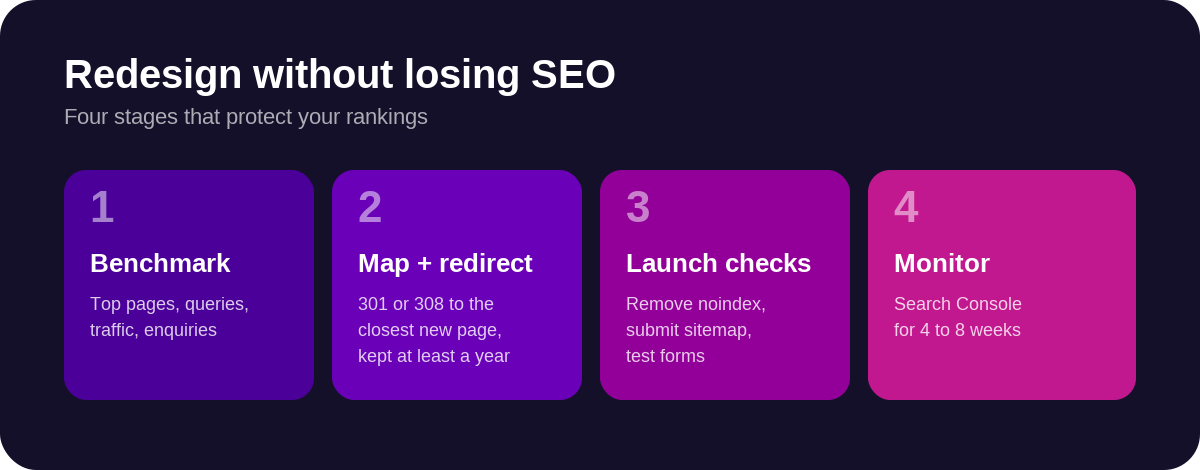
Benchmark rankings, traffic and top pages before you change anything.
Map every old URL to the closest new page with a 301 or 308 redirect.
Keep the content, titles and internal links that already rank.
Remove staging blocks, submit the sitemap and monitor Search Console.
To redesign a website without losing SEO, benchmark your current performance, keep URLs that work, redirect every changed URL to its closest new page with a permanent 301 or 308 redirect, keep the content that ranks, and check Search Console closely after launch. Most ranking drops after a redesign come from missing redirects, deleted content or a new site that Google can't crawl.
This checklist walks through what to do before, during and after launch.
Four stages of a safe redesign
Before: benchmark and inventory
Record your baseline: export top pages, queries and clicks from Google Search Console, plus traffic and enquiries from Analytics.
List every URL: pages, blog posts, PDFs and images that get traffic or links. A content audit shows which pages to keep, merge or remove.
Mark the pages that matter: the pages that bring traffic, links and enquiries are the ones to protect.
During: map URLs and redirect
Situation
What to do
URL stays the same
Keep it. This is the safest option
URL changes
301 or 308 redirect to the matching new page
Pages merged
Redirect each old page to the merged page
Page removed, no equivalent
Redirect to the closest relevant page, or let it return 404
Domain changes
Redirect every URL and use Search Console's Change of Address tool
Google recommends permanent server-side redirects, such as 301 or 308, where possible. Redirect each old URL straight to its final destination rather than through a chain, and don't send everything to the home page.
Google's site move guide says to keep redirects for as long as possible, generally at least a year, so signals and links from other sites carry over.
Keep what ranks
Keep the content, headings and title tags of pages that rank, or improve them; don't cut them to fit a new design.
Carry over structured data, meta descriptions, image alt text and canonical tags.
Rebuild internal links so they point to final URLs, not redirects.
Compare clicks, top queries and enquiries with your baseline every week.
Watch Search Console's Pages report for new 404s and "Excluded" pages.
Fix broken internal links and add any missed redirects.
Some fluctuation after a large move is normal while Google recrawls; a sustained drop usually points to missing redirects or content.
Our free website checker gives a quick read on speed and basic SEO before and after launch.
The bottom line
A redesign protects your SEO when you benchmark first, keep URLs where you can, redirect every changed URL properly, keep the content that ranks and monitor closely after launch. Not sure whether you need a redesign at all? Read redesign or fix your website.
Incinc Media's website team plans redirects and SEO checks into every redesign. Book a free 30-minute strategy call and we'll flag the pages your redesign must protect.
Frequently asked questions
Will my rankings drop after a website redesign?
+
They don't have to. Rankings usually drop when URLs change without redirects, content that ranked is removed, or the new site is blocked from crawling. With proper mapping and redirects, any fluctuation is usually temporary.
How long should I keep 301 redirects?
+
Google recommends keeping redirects for as long as possible, generally at least a year, so it can transfer signals and other sites' links to the new URLs.
Should I change my URLs during a redesign?
+
Only if there's a clear benefit. Keeping URLs the same is the safest option. If you must change them, redirect each old URL to the most relevant new page, not to the home page.
What is the most common redesign SEO mistake?
+
Launching with the staging site's noindex tag or robots.txt block still in place, or forgetting redirects for old pages. Both can remove pages from Google quickly.
What should I check after launch?
+
Test the redirects, submit the new sitemap, check Search Console for crawl errors and indexing issues, compare traffic and enquiries with your benchmark, and fix broken links.
Articles are written and reviewed by the Incinc Media team, the people who plan, design, build and market websites, apps and campaigns for businesses from our head office in Mumbai and our branch offices in Faridabad and Greater Noida. We write about the questions clients ask us every week.
Book a free 30-minute strategy call. We'll review your current site, flag the pages that bring traffic and enquiries, and plan a redesign that protects them.
A redesign is expensive and risky for your search rankings, and sometimes a handful of fixes would do more. Here's how to tell which one your website needs.
Older websites collect thin, outdated and duplicate pages that dilute everything else. A content audit decides what to keep, improve, merge or remove, and how to do it without losing search traffic.
Great content can't rank if search engines can't crawl, understand and trust your pages. Use this checklist to find the technical issues that quietly hold business websites back.
Read
What we do
Everything your brand needs, under one roof.
Technology, creative production and digital marketing from one in-house team, with offices in Mumbai, Faridabad and Greater Noida.