
Website Development · 2 min read
Before You Brief a Website: A Practical Checklist
The clearer the brief, the better the website. Here's what to gather before you speak to any design and development team.
Read
Most website delays come from not knowing what happens next or what's needed from you. Here's the whole process, stage by stage, with your inputs and the agency's deliverables.
Quick answer
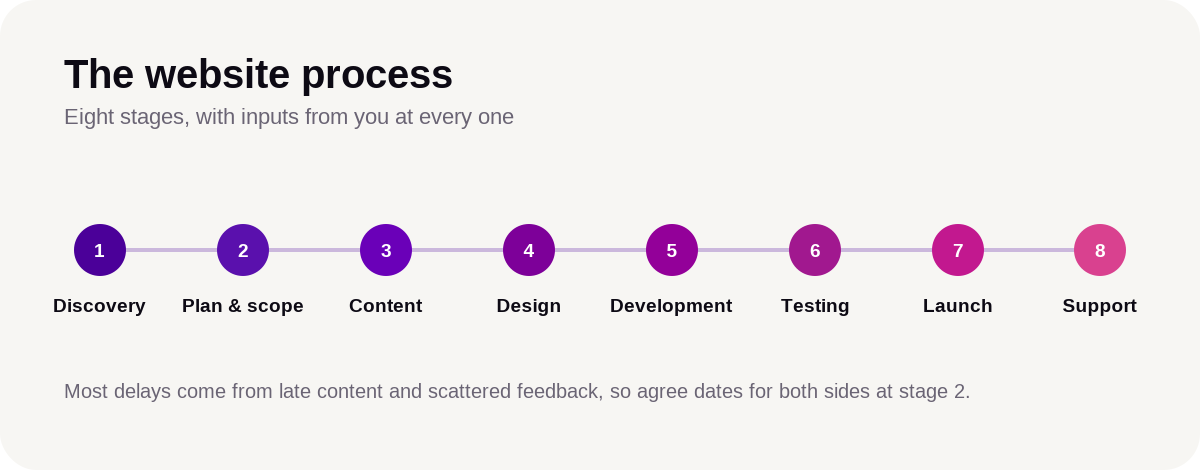
A website project usually runs through eight stages: discovery, planning (sitemap and scope), content, design, development, testing, launch and post-launch support. Each stage has inputs from you (goals, content, feedback, approvals, access) and deliverables from the agency. Timelines depend on scope and how quickly content and feedback arrive, so agree dates for both sides upfront.
A website project can feel like a black box: you pay a deposit, wait, and hope. In reality it's a sequence of stages, each with things the agency delivers and things it needs from you. Knowing the sequence is the best way to keep a project on time.
Here's the full process, from first conversation to life after launch.
What happens: conversations about your business, audience, goals, competitors and what isn't working today.
You provide: goals, examples you like, current site access, analytics if you have them, budget range.
You get: a shared understanding of the problem and a recommended approach.
What happens: a sitemap (list of pages), features, integrations, content plan and platform choice. Read custom website vs WordPress if that's undecided.
You provide: decisions and approval.
You get: a written scope, timeline with dates for both sides, and an itemised quote. Our project brief checklist and cost guide help here.
What happens: writing or gathering text, photos, videos, product data and testimonials.
You provide: content, or input for a copywriter; photos or time for a shoot.
Tip: start content on day one. It's the most common cause of delays.
What happens: wireframes (layout without visual styling), then visual design of key pages on desktop and mobile.
You provide: feedback in agreed rounds, then approval.
You get: approved designs for each unique page layout.
What happens: building the site, connecting the CMS, forms, integrations and tracking.
You provide: access to tools to integrate (CRM, payment gateway, email), and quick answers to questions.
You get: a staging site to review.
What happens:
You provide: a final review on your own devices.
What happens: pointing the domain, SSL, 301 redirects from old URLs, submitting the sitemap to Google Search Console and Bing, and a post-launch check.
You provide: domain and DNS access, and launch approval.
What happens: a bug-fix period, then ongoing maintenance, content updates and improvements based on data. See our website maintenance checklist.
You get: a handover with logins, how to edit content, and ownership of your accounts, domain and files.
It depends on scope and on how quickly inputs and feedback arrive. A compact site on a customised template moves much faster than a custom platform with integrations. Ask for a timeline that includes your dates, not just the agency's.
A smooth website project is a shared plan: clear scope, early content, structured feedback, proper testing and a careful launch. Know the stages and you'll know exactly where your project stands.
Our website development team follows this process on every build. To map your scope quickly, try the free website planner.
It depends on the number of unique page layouts, features, integrations and how fast content and feedback arrive. A small template-based site is far quicker than a custom platform. Ask for a written timeline with dates for your inputs too.
Your goals, brand assets, content (or a brief for copywriting), photos or a shoot plan, timely feedback and approvals, and access to your domain and any existing site.
Usually, but changes after approval can affect cost and timeline. A clear change-request process in the proposal avoids surprises.
Map old URLs to new ones and set up 301 redirects, keep valuable content, and submit the new sitemap. Skipping redirects is the most common way redesigns lose traffic.
A support period for fixes, analytics checks, and then ongoing maintenance: updates, backups, security and content changes.
Written by
Articles are written and reviewed by the Incinc Media team, the people who plan, design, build and market websites, apps and campaigns for businesses from our head office in Mumbai and our branch offices in Faridabad and Greater Noida. We write about the questions clients ask us every week.
Planning a new website?
Map your scope in two minutes with our free planner, or talk to us about a written proposal with clear stages and dates.
Website Development · 2 min read
The clearer the brief, the better the website. Here's what to gather before you speak to any design and development team.
Website Development · 10 min read
Two quotes for 'a website' can differ by ten times, and both can be fair. Here's what actually drives the price, what you'll pay every year after launch, and how to compare quotes properly.
Website Development · 5 min read
WordPress runs a huge share of the web, and custom builds power the fastest, most distinctive sites. The right choice depends on who edits the site, what it must do and how long it needs to last.
Start a project
Whether you need a digital product, a creative campaign or a complete digital transformation, let's build something meaningful together.
Or call +91 81081 14819·mail@incincmedia.com